 Back to the Atlas
1. Aegina, Greece: A rich history
Aegina's position in the Saronic Gulf helped it become a prosperous maritime power. The settlement at Kolona preserves a much longer history, reaching back before the Bronze Age. By the Archaic period, Aeginetan traders operated widely, and the island issued its famous silver turtle coins, among the earliest in Europe, during the sixth century BC; their precise starting date remains debated.
Competition with Athens eventually became open conflict. Aegina surrendered to Athenian power around 457 BC, losing its fleet and paying tribute. In 431 BC, at the beginning of the Peloponnesian War, Athens expelled the Aeginetans and settled Athenians on the island; surviving islanders later returned after Athens' defeat.
During the medieval centuries, settlement concentrated inland at Paleochora, where a hilltop position offered greater security than the exposed coast. Its surviving churches belong to different periods, and the settlement suffered repeated attacks, notably the Ottoman corsair Barbarossa's raid in 1537.
Aegina briefly served as the seat of the emerging Greek government in 1828–1829 under Ioannis Kapodistrias, before the government moved to Nafplio. Harbour buildings and early state institutions preserve that chapter. Calling it the first capital needs this context: revolutionary governments had already operated elsewhere.
2. Aphaia's ridge & the island harbour
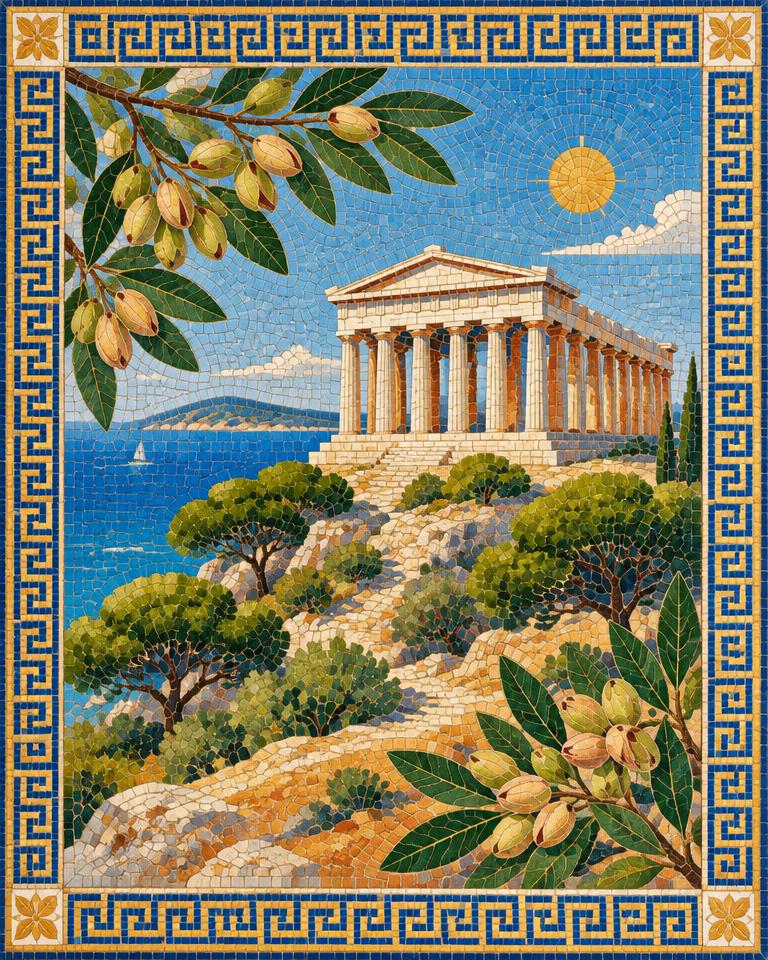
The Temple of Aphaia, built around 500 BC, occupies a pine-covered ridge above the eastern coast. Its surviving Doric colonnades make the structure unusually legible. Many original pedimental sculptures are now in Munich's Glyptothek, while the sanctuary itself preserves the relationship between temple, terrace and landscape.
Modern accounts often connect Aphaia, the Parthenon and Sounion in a near-equilateral sacred triangle. The geometry is not evidence of an established ancient planning scheme. Back near the harbour, Kolona offers a firmer historical anchor: successive settlements and the single surviving column of Apollo's temple stand within walking distance of the waterfront.
3. Top historical sights
Late Archaic; approximately 500 BC
Explore the well-preserved Doric sanctuary on its wooded ridge above the island's eastern coast.
Medieval settlement; largely abandoned in the early nineteenth century
Follow the rough paths between surviving chapels, some retaining wall paintings and irregular opening arrangements.
Prehistoric settlement; Apollo temple around 500 BC
Visit the layered coastal settlement marked by one standing temple column just north of the harbour.
4. The island table: what to eat
Aegina's most portable souvenir is also a serious agricultural product: the local pistachio. Buy from a producer or specialist shop where possible, and ask about origin rather than assuming every green confection in the harbour grew nearby.
Cultivation established in the later nineteenth century; EU PDO registered in 1996
Taste the island's small rich nuts plain or roasted to appreciate them without a supporting cast of sugar.
Longstanding Greek island seafood tradition
Order tenderised octopus finished over the grill, often served simply with olive oil and vinegar or lemon.
Traditional preserve style shaped by wider eastern Mediterranean cookery
Try young green pistachios preserved in syrup and served in a small portion beside water or coffee.
5. Explorer's conclusion
Ferries from Piraeus to Aegina vary by vessel, with faster services taking roughly 40 minutes and conventional crossings often around an hour or more. Check the specific sailing and return connection, especially outside summer. Reaching Aphaia and Paleochora requires planning around buses, taxis or a hired vehicle.
A day trip can comfortably introduce the harbour and one major outing; staying overnight leaves room for the quieter lanes and a less hurried meal. Once the returning excursion boats depart, Aegina becomes noticeably better at being an island rather than an extension of an Athens itinerary.
Site by Dan Vineyard — images and site © 2026