 Back to the Atlas
1. Chania, Greece: A rich history
Chania sits on the northwest coast of Crete, built directly on top of Kydonia, a Minoan city so old that Homer listed it among the great towns of the island. People have lived on this exact spot for roughly 5,000 years, which makes Chania one of the oldest continuously inhabited places in Europe. The Minoan ruins are not in a fenced park outside town — they are under your feet, on Kastelli hill, between the tavernas.
What you see today is mostly the Venetian city (1204–1669) wrapped in an Ottoman one (1669–1898). The result is a crescent harbour of arsenals and warehouses, a lighthouse, a pink-domed mosque, synagogue lanes, and minarets — all within a fifteen-minute walk.
2. The Old Town & Venetian Harbour
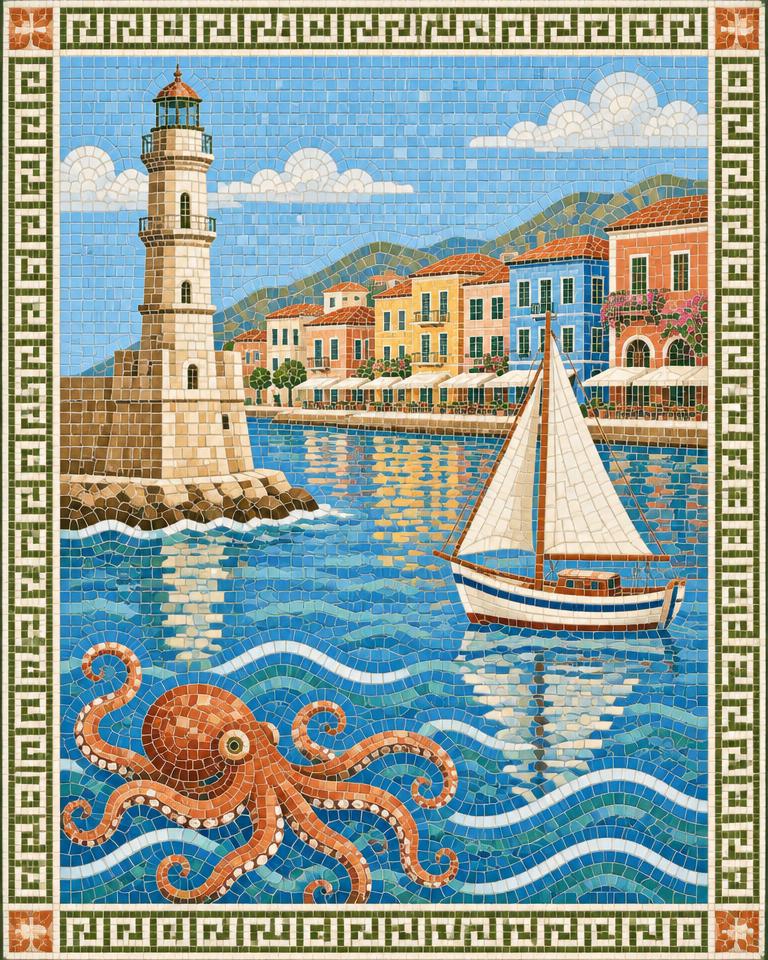
The Venetian harbour is the heart of it. The Venetians fortified the crescent in the 14th century, and the long row of arched shipyards — the arsenali — still stands along the eastern side. At the harbour mouth, the lighthouse was rebuilt in its current form in 1838 by the Egyptians, which is why it looks more like a minaret than a Greek tower.
Walk inland and the quarters change flavour street by street: the Jewish quarter around Etz Hayyim synagogue, the Turkish quarter of Splantzia with its plane-tree square, and the Kastelli hill where Minoan Kydonia is still being excavated between the houses.
3. Top historical sights
Harbour 14th c.; lighthouse 1838
The crescent of arsenals, the Kucuk Hasan mosque and the Egyptian lighthouse — best at dusk when the lamps come on.
New museum opened 2022; finds c. 3500 BC–Roman
Now in a purpose-built home in the Halepa district: Minoan seals, Linear A tablets and Roman mosaics from Kydonia.
National park since 1962; refuge for centuries
A 16 km walk down Europe's longest gorge, from the White Mountains to the Libyan Sea, through the Iron Gates.
Natural lagoon; Venetian fort 1579
A shallow turquoise sandbar guarded by a Venetian island fortress — reach it by boat from Kissamos or down a steep track.
Protected nature reserve
Pink-sand shallows on the southwest tip of Crete, a nature reserve of dunes and rare sea daffodils.
4. The Cretan table: what to eat
Ottoman-era Cretan
Chania's signature bake: layered zucchini and potato under a rich staka custard, found in old-town tavernas.
Byzantine-era Cretan
The town's own cheese pie, pinched closed like a dumpling and dusted with sugar and cinnamon.
Ottoman-era shepherd's cooking
Goat's-milk butter cooked down until creamy, then fried with eggs — a White Mountains shepherd's breakfast.
Rusks ancient; tomato version 20th c.
Hard barley rusk soaked soft under tomato, mizithra and olive oil — the Cretan answer to bruschetta.
5. Explorer's conclusion
Chania rewards the slow traveller. Give it three days: one for the harbour and old town, one for the museum and Kastelli hill, and one for the mountains or the lagoon. Come in May or late September, when the gorge is open, the sea is warm and the cruise crowds are gone.
Site by Dan Vineyard — images and site © 2026