 Back to the Atlas
1. Corfu, Greece: A rich history
Corfu is often identified with Scheria, the island of the Phaeacians where Homer’s Odysseus meets Nausicaa. The association is enduring, not proven geography. Ancient Corcyra was settled by colonists from Corinth around 734 BC, and its later conflict with its mother city helped draw Athens towards the Peloponnesian War.
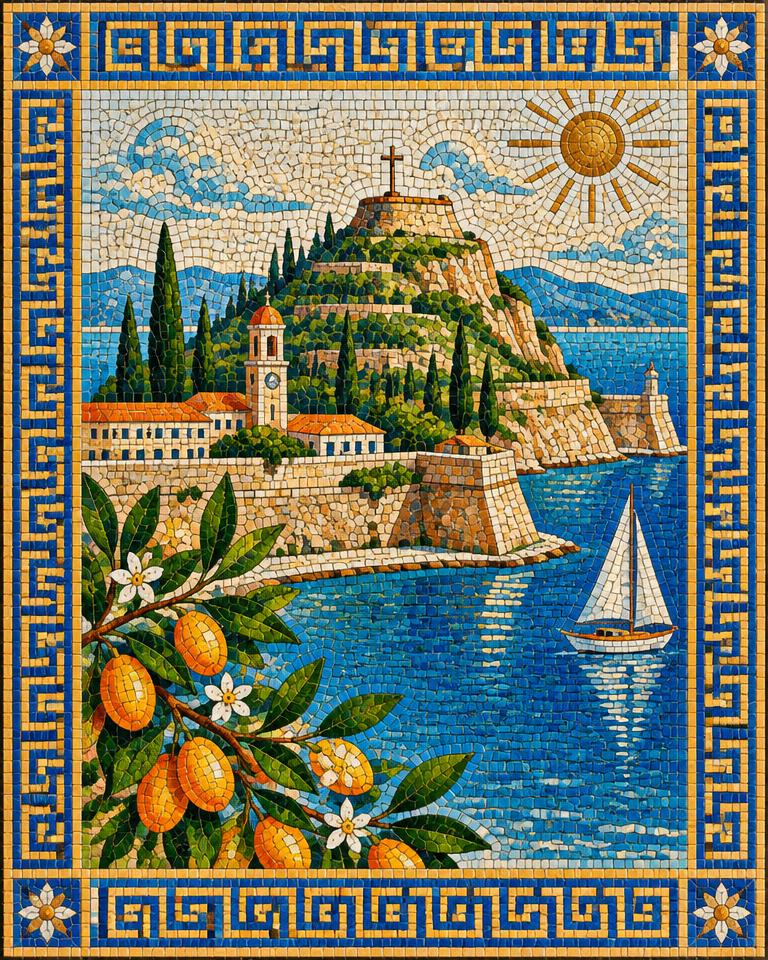
Roman, Byzantine and competing western rulers followed. The defining period for today’s town was Venetian rule from 1386 to 1797. Corfu resisted major Ottoman attacks, including the siege of 1716, and unlike much of Greece never came under Ottoman rule. Its fortresses were practical investments in survival, not merely future viewpoints.
After Venice fell, Corfu experienced French rule, the Septinsular Republic under Russian-Ottoman protection, another French administration and then the British-protected United States of the Ionian Islands from 1815. The Liston belongs to the French period, while cricket recalls the British presence; not every Italian-looking arcade is Venetian.
The Ionian Islands united with Greece in 1864. Empress Elisabeth of Austria commissioned the Achilleion, completed around 1890, as a retreat shaped by her admiration for Achilles. Corfu suffered bombing and occupation during the Second World War, and its Jewish community was devastated by deportation in 1944. The old town’s UNESCO inscription in 2007 recognises an urban landscape with a complex history, not just an attractive façade.
2. The old town & the island beyond
Begin at the Old Fortress, then cross the Spianada towards the Liston and the old town’s narrow lanes. The New Fortress, begun under Venice in the late sixteenth century, guards the other side of the historic centre. Despite its name, it has had ample time to settle in.
Outside town, the Achilleion at Gastouri offers another era entirely, though restoration can affect access to its interiors and gardens. Paleokastritsa combines wooded slopes, coves and a monastery traditionally founded in 1225, whose visible buildings are largely later. Mouse Island, or Pontikonisi, makes a separate short outing near Kanoni when local boats are operating.
3. Top historical sights
The UNESCO-listed old town is best explored on foot, with time for both fortresses and the streets between them.
Byzantine origins; major Venetian works 15th–16th century
A sea-facing stronghold occupies the twin-peaked headland that helped shape the town’s defences.
Completed c. 1890
Empress Elisabeth’s retreat celebrates Achilles through classical imagery and a hillside setting.
Traditional foundation 1225; mainly later buildings
A clifftop monastery overlooks turquoise coves on Corfu’s western coast.
Liston begun during French rule, early 19th century
Arcades and open public space reveal layers of civic life beyond the Venetian period.
4. The Corfiot table: what to eat
Corfiot cooking carries Venetian influences, but recipes have changed over time: tomato sauces are a post-Columbian development, not an ancient inheritance.
Venetian-influenced island tradition; later tomato sauce
Rooster or beef in a spiced tomato sauce comes over pasta and requires little assistance from a starter.
Venetian-influenced Corfiot tradition
Thin slices of veal cook with white wine, garlic and parsley in one of the island’s signature dishes.
Kumquats introduced in the 19th century
Sweet orange-coloured liqueur turns an imported citrus fruit into an unmistakably local souvenir.
5. Explorer's conclusion
Give the old town a full day and keep another for Gastouri or the west coast rather than attempting every landmark before lunch. Confirm Achilleion access before travelling, carry water for fortress climbs and allow for slow summer roads. Local boat trips depend on weather and season.
Corfu is not simply a Greek island wearing Italian architecture. Its character comes from the accumulation: ancient seaways, Venetian engineering, French arcades, British cricket and kitchens that have made those encounters their own.
Site by Dan Vineyard — images and site © 2026