 Back to the Atlas
1. Corinth, Greece: A rich history
Corinth grew wealthy by controlling the isthmus between mainland Greece and the Peloponnese. Its ports at Lechaion on the Corinthian Gulf and Kenchreai on the Saronic Gulf connected two maritime trading networks, while the ancient Diolkos provided an overland transport route across the narrow neck of land.
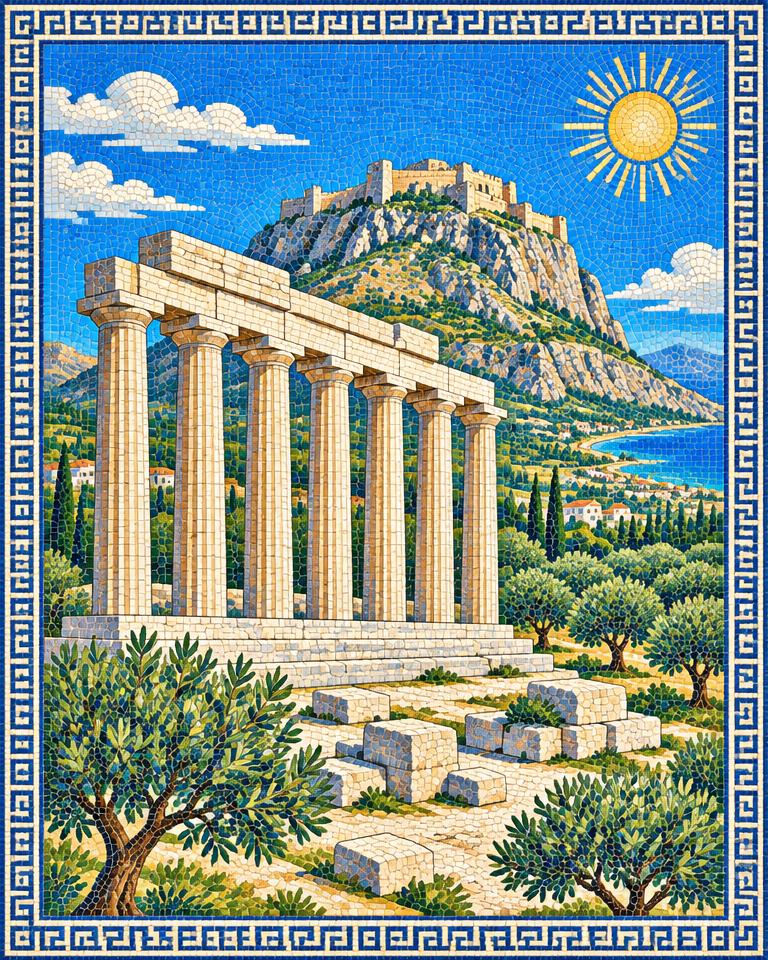
Archaic Corinth exported pottery and founded colonies, including Syracuse in 734 BC according to the traditional chronology. The surviving Temple of Apollo, built around 560 BC, belongs to this prosperous period; seven of its Doric columns remain standing.
Roman forces under Lucius Mummius destroyed the city in 146 BC. Julius Caesar refounded it as a Roman colony in 44 BC, and it became the provincial capital of Achaia. Paul preached here in the first century AD; Acts associates his appearance before the proconsul Gallio with a tribunal, traditionally linked to the surviving bema.
Above the city, Acrocorinth accumulated ancient, Byzantine, Frankish, Ottoman and Venetian defences. Modern Corinth developed nearer the coast after the destructive earthquake of 1858, while the canal finally opened in 1893, completing a project contemplated in antiquity but not finished by ancient engineering or imperial enthusiasm.
2. Ancient Corinth, Acrocorinth & the isthmus
Ancient Corinth lies southwest of the modern city. Walk between the Temple of Apollo, Roman forum and Peirene Fountain, using the site's museum to put the scattered architecture into context. The bema associated with Paul is worth examining as both a Roman civic monument and a later place of Christian remembrance.
Acrocorinth is a separate uphill expedition, not a quick extension of the forum. Its successive gateways and extensive walls reward sturdy shoes, drinking water and an early start. Much of what survives reflects medieval and later rebuilding, so the fortress should not be assigned to one neat century.
At the Corinth Canal, viewpoints reveal the dramatic cut through the limestone isthmus. Check access and boat-operation information before travelling specifically for a crossing, and keep to designated viewing areas rather than negotiating with the edge.
3. Top historical sights
The region's three headline stops tell different stories: ancient commerce, fortified high ground and the engineering of the 1893 canal.
Temple c. 560 BC; extensive Roman remains
Seven surviving Doric columns overlook a site containing the Roman forum, Peirene Fountain and bema.
Ancient origins; Byzantine and later fortifications
This vast mountaintop fortress preserves successive Byzantine, Frankish, Ottoman and Venetian interventions.
Opened 1893
The narrow canal cuts through the isthmus to connect the Corinthian and Saronic gulfs.
4. The Corinthian table: what to eat
Regional produce makes a useful introduction to Corinthia beyond the ruins. Try local olive oil, look for dried currants and explore Nemea's Agiorgitiko wines; ancient viticulture does not, by itself, prove an ancient pedigree for a named modern grape variety.
Documented medieval trade; especially from the 13th century
These small dried grapes take their English name from Corinth and suit both baking and savoury dishes.
Traditional regional cultivar
Manaki olives produce aromatic oil, though individual groves should not be assumed to date from antiquity.
Modern PDO designation established in 1971
Nearby Nemea produces red wines from Agiorgitiko in a region with a long history of viticulture.
5. Explorer's conclusion
Allow a full day for Ancient Corinth, Acrocorinth and a canal stop, preferably with your own transport. Check separate site hours, carry water and avoid tackling the fortress in peak summer heat. Add a second day for Nemea's archaeology and wineries, arranging a driver if tasting is part of the plan.
Corinth is more than a brief stop between Athens and the Peloponnese. From the fortress, its old strategic advantage becomes obvious: two seas, a narrow crossing and an excellent position for charging someone to pass through.
Site by Dan Vineyard — images and site © 2026