 Back to the Atlas
1. Epidaurus, Greece: A rich history
The sanctuary of Epidaurus developed inland from the coastal city, in a landscape already associated with the worship of Apollo Maleatas. The cult of Asclepius became established here around the sixth century BC, and the site grew into one of the Greek world's most influential healing centres. Its importance lay in a combination of sacred authority, ritual practice and an expanding international reputation.
Patients sought healing through purification, offerings and ritual sleep, or incubation, in the Abaton. Dreams might reveal the god's intervention or prescribe a course of action. Surviving cure inscriptions record the sanctuary's claims and religious outlook; they are not clinical trials, however confidently a miraculous recovery is described.
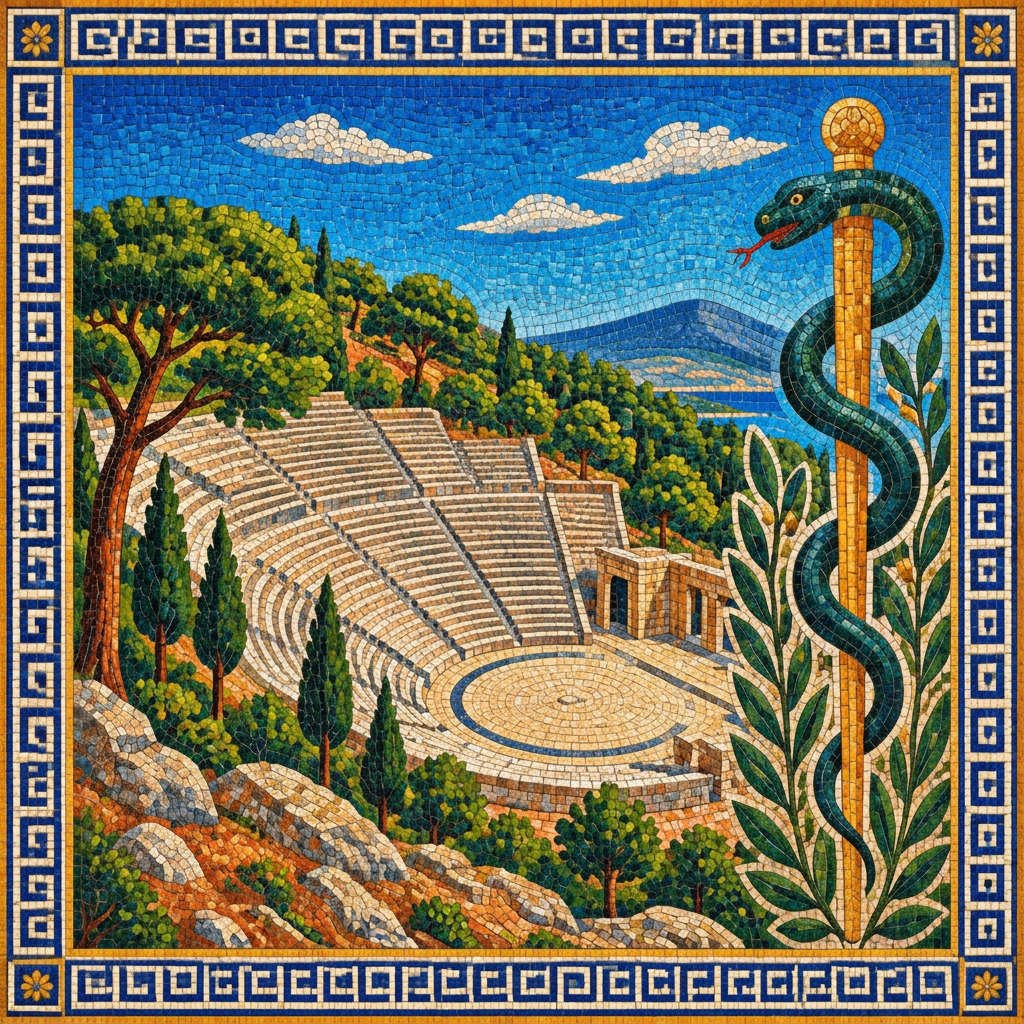
The fourth century BC brought an ambitious building programme, including the temple of Asclepius, the circular Tholos and the theatre. The traveller Pausanias, writing in the second century AD, attributed the theatre and round building to Polykleitos, conventionally identified as Polykleitos the Younger. The theatre's initial phase is usually placed in the later fourth century BC, often around 340–330 BC.
The sanctuary remained important under Roman rule, receiving new buildings and repairs, before declining in late antiquity. Excavation and restoration made its monuments accessible again, and performances returned to the ancient theatre in modern times. UNESCO listed the sanctuary in 1988, recognising a place where religious healing, architecture and performance developed together.
2. The theatre & the sanctuary landscape
The Ancient Theatre of Epidaurus seats roughly 13,000–14,000 people after its ancient enlargement. Its clarity of sound is exceptional, helped by the design and the surrounding conditions, but the familiar claim that every whisper reaches every seat is an exaggeration. A quiet spoken demonstration is more revealing than an audience of visitors all testing the acoustics at once.
Give the sanctuary beyond the theatre equal time. The stadium, temple foundations and Abaton explain the wider setting, while the Tholos preserves an unusual concentric underground arrangement whose precise purpose remains debated. The small museum displays architectural pieces, inscriptions and medical instruments; check current access and displays rather than assuming every object will be on view.
3. Top historical sights
The UNESCO-listed sanctuary is best understood as a connected complex, not simply a famous theatre with some ruins attached.
Initial phase c. 340–330 BC; enlarged in the Hellenistic period
The exceptionally preserved theatre combines celebrated acoustics with a capacity of roughly 13,000–14,000 spectators.
Cult established c. sixth century BC; active into late antiquity
Temple remains, sleeping halls and athletic buildings reveal a major religious centre devoted to healing.
Fourth century BC, commonly c. 360–320 BC
This circular monument contained concentric underground passages whose exact ritual function remains uncertain.
4. The Argolid table: what to eat
Head toward the coast for fish, or look inland for seasonal vegetables such as Argolid artichokes; these are regional meals rather than a reconstructed ancient treatment plan.
Long-cultivated Mediterranean crop; local spring speciality
Tender artichokes are often cooked with olive oil, lemon and dill, sometimes alongside peas or potatoes.
Longstanding coastal food tradition
Simply grilled sardines make a good seaside meal when available, though the day's catch and sourcing vary.
Regional olive-oil pie traditions
Ask how the kitchen makes its ladopita, since the name covers different oil-rich pies and flatbreads across Greece.
5. Explorer's conclusion
Allow at least half a day for the theatre, sanctuary and museum, starting early when the weather is hot. The principal archaeological site is inland, not beside the harbour at Palaia Epidavros, so confirm your destination when arranging transport. For a summer performance, check the Athens Epidaurus Festival programme, language arrangements and return journey before booking.
Wear shoes suited to uneven ground and steep theatre steps, and carry water for the open sanctuary. End on the coast if time permits: after a day considering sacred dreams and ancient medicine, a quiet harbour dinner is a pleasant modern option, with no miracle claims required.
Site by Dan Vineyard — images and site © 2026