 Back to the Atlas
1. Heraklion, Greece: A rich history
Heraklion is the lively capital of Crete, on the island’s north coast. Its greatest ancient neighbour, Knossos, lies about five kilometres inland. The two belong together on an itinerary, but they are not the same city: the Bronze Age palace stands outside the modern harbour town.
People settled at Knossos around 7000 BC. A first palace arose around 1900 BC, followed by rebuilding after destruction around 1700 BC. Its courtyards, storerooms, workshops and painted rooms reveal a society tied into eastern Mediterranean trade. “Minoan” is a modern name, popularised by Arthur Evans and drawn from the legendary King Minos; the Minotaur is mythology, not an excavated tenant.
Many Cretan palaces were destroyed around 1450 BC, while Knossos continued under rulers using Linear B, an early form of written Greek. The older Linear A script remains undeciphered. The palace’s final chronology is debated, so the island’s changes should not be reduced to one volcanic eruption or one tidy date. Later Knossos remained inhabited through Greek and Roman times; Rome conquered Crete in 67 BC.
The harbour town’s medieval story begins in earnest with the Arab emirate of Crete in the ninth century. Its fortified capital was called al-Khandaq, referring to its defensive ditch. Byzantine forces under Nikephoros Phokas recovered it in 961. Venice acquired rights to Crete after the Fourth Crusade in 1204 and established control during the following years; the city became Candia, the centre of a long-lived maritime colony.
Venetian rule brought monumental walls, fountains, churches and the harbour fortress. It also nurtured the Cretan Renaissance: El Greco, born on Crete in 1541, trained in its artistic world before moving west. Ottoman troops besieged Candia from 1648 to 1669, an extraordinary twenty-one years, before the city surrendered. Crete became autonomous in 1898 and united with Greece in 1913; the fighting and bombing of 1941 added another painful layer.
2. Knossos & the Venetian harbour
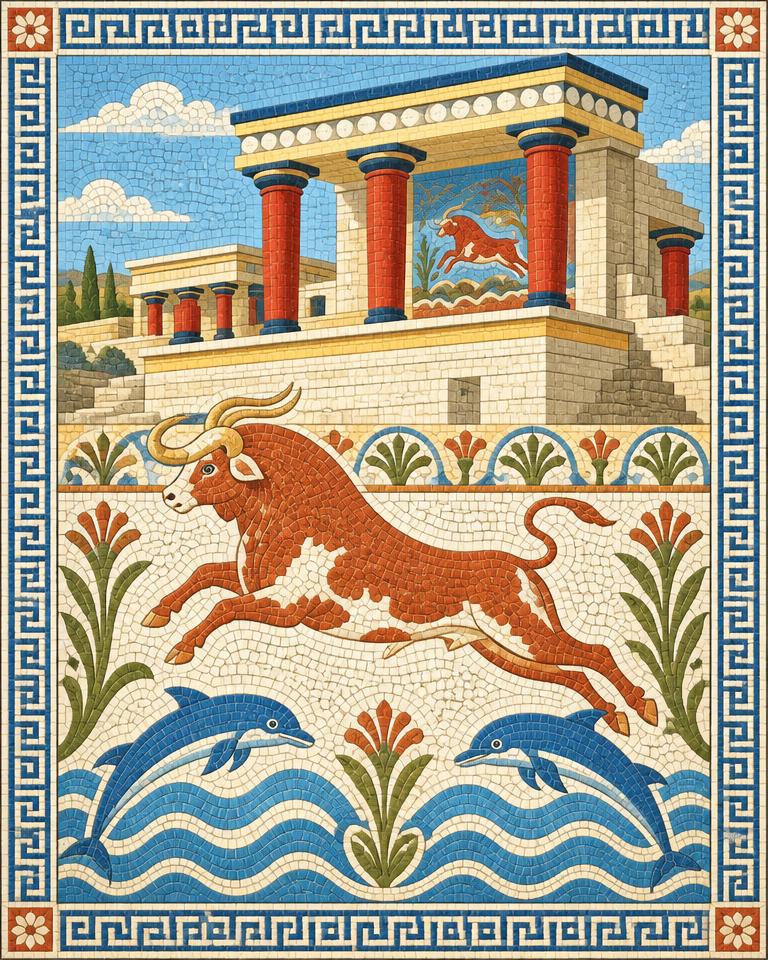
Start at Heraklion Archaeological Museum, then visit Knossos with those original objects fresh in your mind. The bull-leaping fresco, snake-goddess figurines and Phaistos Disc make the palace more than a maze of low walls. The disc’s meaning remains unresolved: anyone offering its definitive translation over coffee deserves a raised eyebrow.
Evans began major excavations in 1900 and reconstructed parts of Knossos using modern materials. The red columns and painted interiors are memorable, but some reflect his interpretations rather than surviving Bronze Age fabric. Read the signs and distinguish original remains from reconstruction; a guide can help considerably.
Back in town, follow the old harbour to Koules, then walk inland to the Morosini Fountain and Venetian Loggia. The fountain dates to 1628; the loggia belongs to the same early-seventeenth-century civic landscape. For a quieter finish, walk a stretch of the Venetian walls to the tomb of Nikos Kazantzakis, the author of Zorba the Greek, who died in 1957.
3. Top historical sights
First palace c. 1900 BC; rebuilt c. 1700 BC
The great Minoan palace, with original ruins alongside Evans’s twentieth-century reconstructions. Visit early for cooler walking.
Collections from Neolithic to Roman Crete
Essential context for Knossos: original frescoes, fine pottery, jewellery and the still-enigmatic Phaistos Disc.
Built 1523–1540
Thick-walled sea fortress at the old harbour entrance, a reminder of Candia’s strategic place in Venetian trade.
Fountain 1628; loggia early 17th century
Lion sculptures and arcaded civic architecture at the centre of a compact old-town walk.
Walls mainly 16th century; writer died 1957
Fortifications enclosing the old city, with the writer’s grave on Martinengo bastion and views over the rooftops.
4. The Cretan table: what to eat
Traditional rusk; tomato topping is post-antiquity
Barley rusk softened with tomato, olive oil and fresh cheese. Simple ingredients, absolutely no interest in being a small portion.
Cretan cheese-pie tradition
Small pies filled with soft local cheese, sometimes sweet and sometimes with herbs. Styles vary by village and season.
Traditional Cretan open-fire cooking
Salted pieces of lamb arranged facing a fire and roasted slowly; look for a kitchen specialising in the method.
Cretan grape-distilling tradition
The spirit also called raki, served with little plates of cheese, olives or seasonal vegetables. Sip slowly; hospitality is not a timed event.
5. Explorer’s conclusion
Allow two or three days: one for the museum and old town, another for Knossos and a relaxed Cretan meal, and a third for wine country or a beach along the north coast. Spring and autumn usually make ruins more comfortable than midsummer. Check current opening times and ticket arrangements before setting out; the palace is exposed to the sun, so bring water, a hat and proper walking shoes.
Heraklion is a working city rather than a postcard village. Give it time and its traffic gives way to a much longer story: Minoan craftsmen, Venetian engineers, Cretan writers and a harbour that has been connecting worlds for centuries.
Site by Dan Vineyard — images and site © 2026