 Back to the Atlas
1. Knossos, Greece: A rich history
Knossos was occupied from around 7000 BC, long before its famous palace existed. By about 1900 BC, a major palatial complex had developed here, coordinating storage, production, ceremony and exchange in a society connected to the wider eastern Mediterranean.
Rebuilding around 1700 BC helped create the elaborate complex visitors recognise today. “Minoan” is a modern archaeological label drawn from the legendary King Minos, not a surviving statement of what these people called themselves. The Minotaur and labyrinth belong to Greek mythology, not to an excavated livestock inventory.
After destruction affected many Cretan centres around 1450 BC, Knossos continued as an administrative centre using Linear B, which records an early form of Greek. The chronology of the palace’s final destruction remains debated. The earlier Linear A script remains undeciphered, so confident translations of its accounts should be approached with care.
Minos Kalokairinos made early excavations in 1878; Arthur Evans began much larger investigations in 1900. Evans reconstructed parts of the palace using modern materials and interpretations that remain controversial. Those red columns and painted rooms are memorable, but they combine Bronze Age evidence with twentieth-century decisions.
2. Palace rooms and the museum originals
Walk around the central court before concentrating on individual rooms. Storerooms, light wells and staircases give a sense of how the complex handled supplies, movement and display. The Throne Room contains a gypsum seat often advertised as Europe’s oldest throne, although both its function and the identity of its occupant remain uncertain.
The Grand Staircase is an impressive introduction to multistorey planning, but the visible structure includes substantial modern reconstruction. Access to individual palace areas can change for conservation or visitor management, so do not assume every staircase is a route you can take.
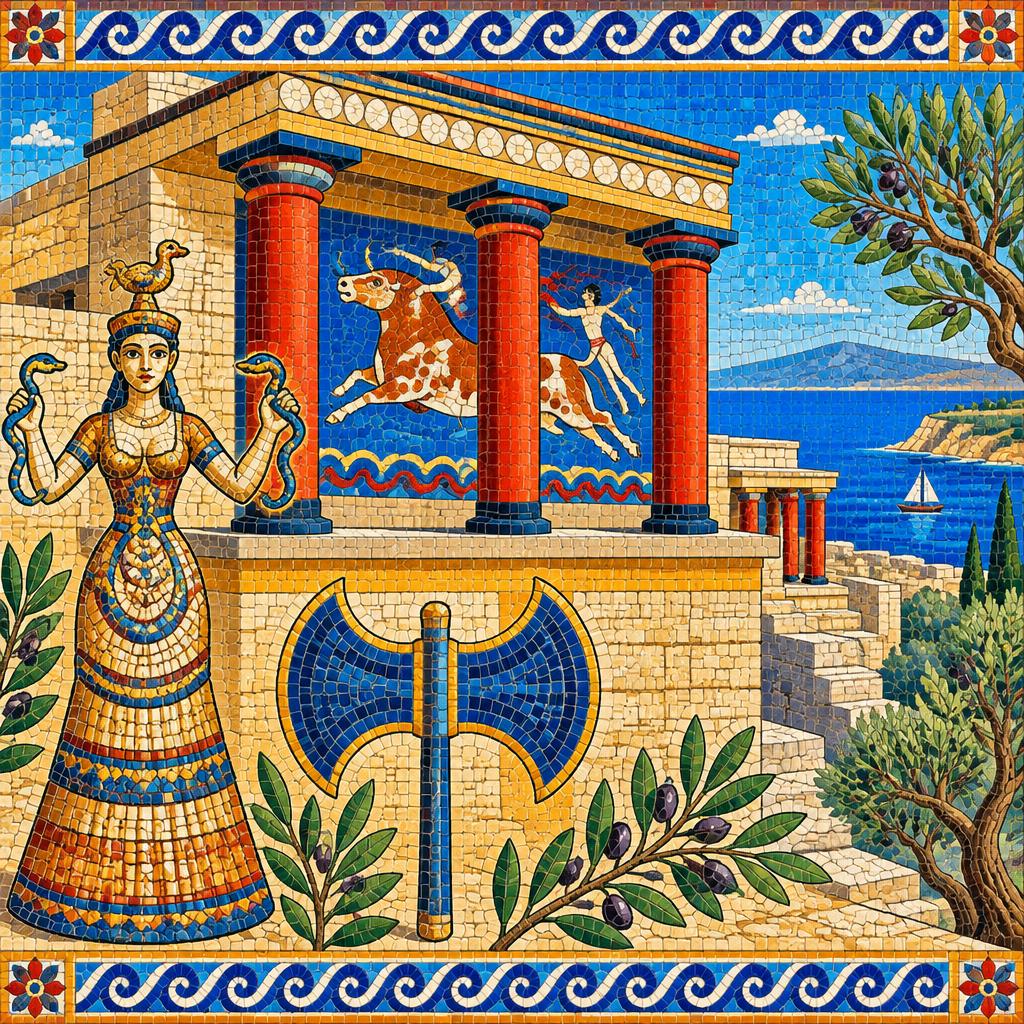
Pair the site with Heraklion Archaeological Museum, where original fresco fragments and other finds supply essential context. The famous bull-leaping image is itself assembled and restored from fragments; its acrobats are evidence for imagery and ritual interests, not a complete instruction manual.
3. Top historical sights
Late Bronze Age; present display partly reconstructed
The gypsum seat and restored griffin imagery mark a ceremonial space whose precise function remains debated.
Second-palace period; conserved and reconstructed after 1900
This light-well staircase shows the palace’s vertical organisation while also revealing the extent of Evans’s intervention.
Approximately 1450 BC; reconstructed from fragments
See the original surviving fragments of Knossos’s best-known athletic image in the archaeological museum.
Reading about Evans’s reconstructions before visiting makes the distinction between ancient fabric and modern presentation much clearer.
4. The Cretan table: what to eat
Traditional Cretan wedding dish
Rice cooked in rich meat broth brings the generosity of a wedding table to a very ordinary lunch.
Regional cheese-pie tradition from Sfakia
This thin cheese-filled pie is commonly served with honey and is worth seeking out in a kitchen that makes it fresh.
Traditional Cretan shepherd cooking
Salted lamb cooks slowly facing an open fire rather than turning directly over the flames.
These are living Cretan traditions, not a reconstructed Minoan menu; antikristo needs a skilled cook more than a Bronze Age origin story.
5. Explorer's conclusion
Visit early for cooler conditions and allow several hours, with a separate generous block for the museum in Heraklion. Check current tickets and opening hours, carry water and wear shoes suited to uneven surfaces. A knowledgeable guide can help disentangle phases that the surviving walls do not conveniently label for themselves.
Knossos is most rewarding when approached as both an ancient palace and a history of archaeology. The real achievement is not finding the Minotaur’s address, but recognising how much survives and how much remains open to interpretation.
Site by Dan Vineyard — images and site © 2026