 Back to the Atlas
1. Kos, Greece: A rich history
Kos is closely associated with Hippocrates, traditionally born on the island around 460 BC. His name became central to Greek medicine, although the Hippocratic Corpus contains works by several authors rather than the collected notes of one exceptionally busy doctor.
The present town developed from a new urban foundation in 366 BC. Its ancient agora and later Roman buildings reflect a prosperous harbour community connected to Aegean trade. Earthquakes repeatedly reshaped that landscape, exposing some remains and damaging others.
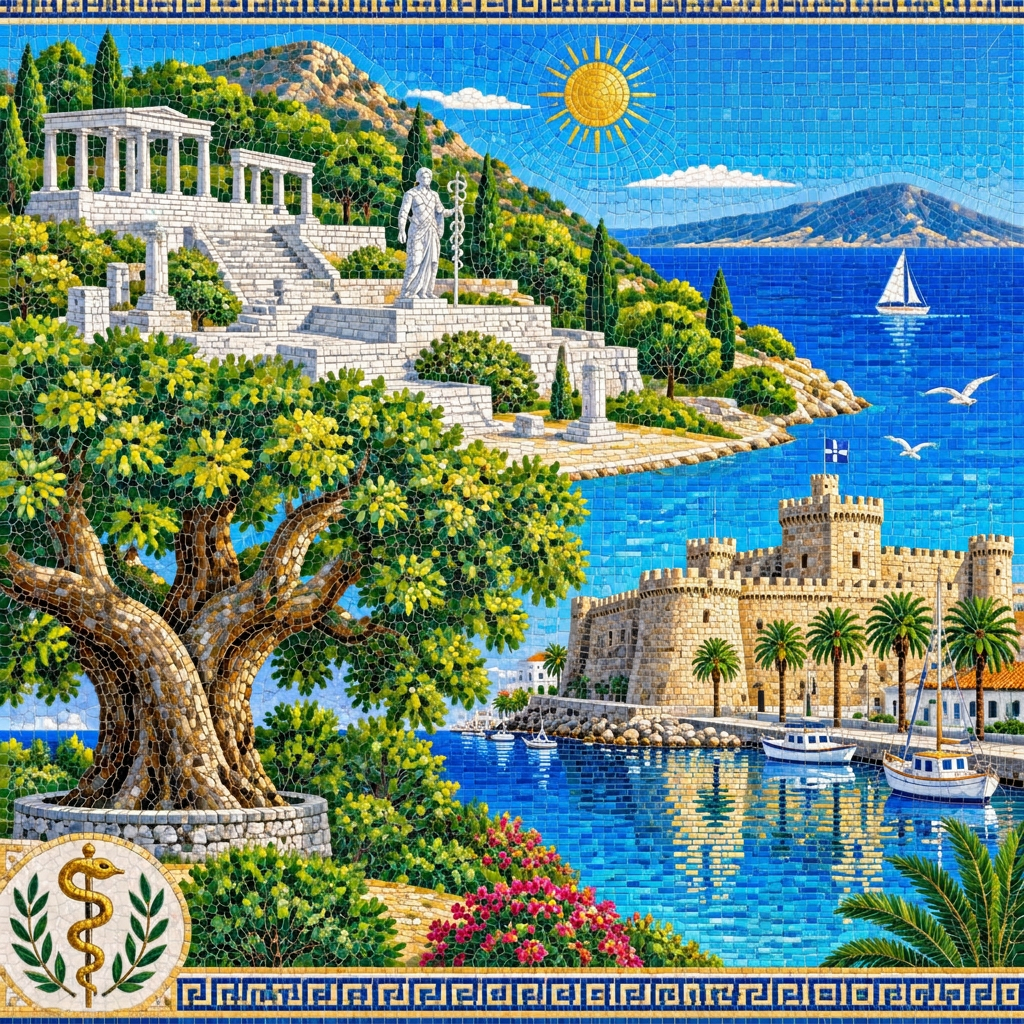
The Asklepieion developed after Hippocrates’s lifetime, with major monumental phases in the Hellenistic period. Dedicated to Asklepios, the god of healing, it combined religious observance with a setting associated with medical practice; it was not a modern hospital wearing classical columns.
The Knights of St John established control in the early fourteenth century and strengthened the harbour with the fortress now called Neratzia. Ottoman rule followed in 1523. Italy occupied Kos in 1912, German forces took the island in 1943, and the Dodecanese formally united with Greece in 1948.
2. The Asklepieion and the harbour town
Above town, the Asklepieion’s terraces arrange sacred buildings and stairways across a green hillside with views toward the coast. Surviving remains belong to several phases, so a single construction date cannot explain the whole sanctuary.
Back near the harbour, the celebrated Plane Tree of Hippocrates commemorates a teaching tradition rather than supplying botanical proof of it. The present tree is far too young to have shaded Hippocrates himself; its estimated age and claims of descent should not be confused with a documented family tree.
Combine the tree and castle exterior with the ancient agora, Roman odeon and mosaic-rich Casa Romana. Castle access and individual archaeological areas may change during conservation work, so confirm openings locally rather than planning an entire afternoon around one locked gate.
3. Top historical sights
Late 4th century BC onward; major Hellenistic building phases
The terraced sanctuary of Asklepios brings together healing traditions, monumental architecture and wide coastal views.
Present tree centuries old; teaching association traditional
The harbour-side plane preserves the memory of Hippocrates without being the tree under which he personally taught.
Main surviving fortifications 15th–early 16th centuries
Neratzia’s harbour defences incorporate reused ancient stonework and reflect the military concerns of the Knights of St John.
The Casa Romana makes a useful additional stop for anyone interested in the island’s Roman domestic life.
4. The island table: what to eat
Traditional island cheese preservation
Also spelled possa, this firm local cheese develops its distinctive character through maturation in red wine.
Traditional Dodecanese pastry
On Kos these fried pastries commonly combine cheese with a sweet finish of honey or syrup and cinnamon.
Traditional cinnamon cordial
A sweet cinnamon-based syrup is diluted with cold water for a refreshing island drink whose recipes vary.
Look for locally made posa cheese rather than assuming every cheese platter on the waterfront is an island speciality.
5. Explorer's conclusion
Allow several days for town, the Asklepieion and time beyond the archaeological sites. Cycling works especially well on the flatter coastal ground around Kos town, but the entire island is not flat: Zia and the Dikaios slopes require a different level of effort. Carry water, use lights after dark and check road conditions before committing to a route.
Kos is strongest when you let its layers share the day: sanctuary terraces in the morning, Roman courtyards later and the harbour at dusk. Hippocrates cannot prescribe your holiday, but a slower pace seems a defensible interpretation.
Site by Dan Vineyard — images and site © 2026