 Back to the Atlas
1. Meteora, Greece: A rich history
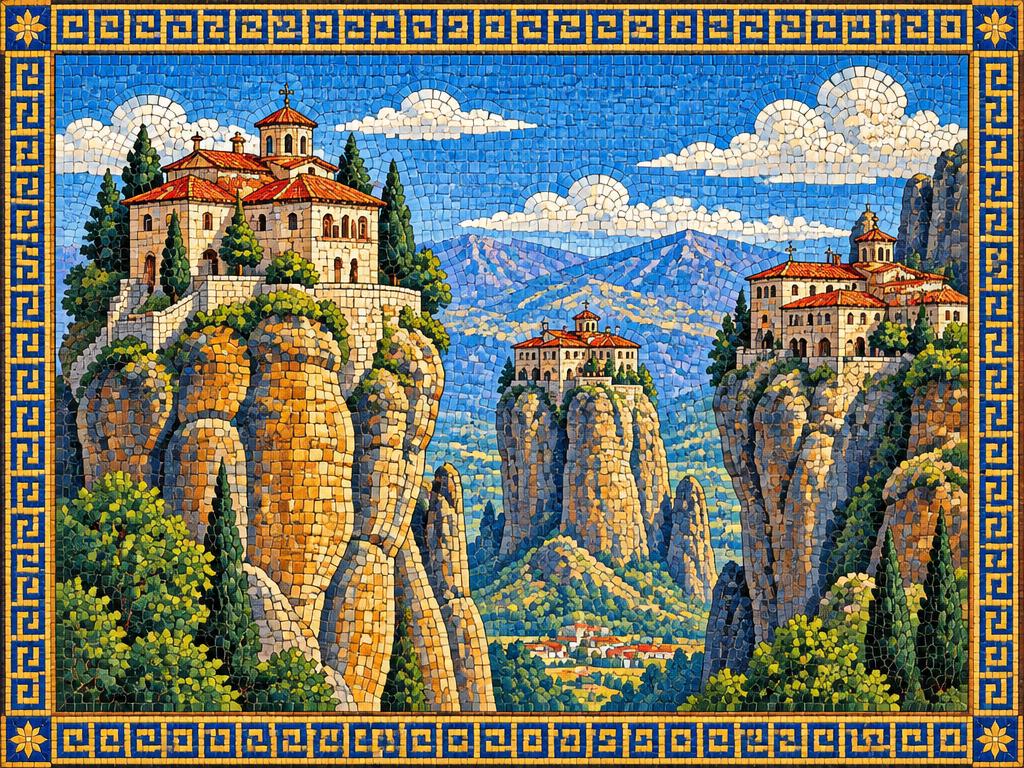
Meteora rises above the Thessalian plain near Kalambaka and Kastraki, its sandstone and conglomerate pillars shaped by uplift, weathering and erosion. Their geological history spans tens of millions of years; a single birthday for the whole landscape would be misleading. The name is commonly rendered as “suspended in the air”, which is unusually direct advertising.
Hermits were occupying caves and fissures by about the eleventh century. Small religious communities followed, finding isolation in a landscape that made casual callers distinctly unlikely. In the fourteenth century, Athanasios the Meteorite established the community that became the Great Meteoron, traditionally dated to around 1356.
Monastic building flourished particularly in the fifteenth and sixteenth centuries. Across its history, Meteora supported roughly two dozen monasteries, although these did not all necessarily flourish at the same moment. Ladders, ropes and hoisting nets provided access to some foundations before modern stairs and bridges; these were working religious houses, not a medieval adventure park.
Six monasteries remain active today, housing communities of monks or nuns. Their churches preserve important post-Byzantine painting, while manuscripts and objects record centuries of religious life. UNESCO inscribed Meteora in 1988 for both its cultural and natural significance, a useful reminder that the buildings and the rocks deserve equal attention.
2. Monastery circuits & paths above Kastraki
The Great Meteoron and Varlaam make a natural pairing, combining substantial monastic buildings with frescoed churches and broad views. Varlaam's present community was re-established in 1517 on a site previously occupied by a fourteenth-century hermit. Its principal church dates to the sixteenth century, not to the first arrival on the rock.
Holy Trinity stands on an especially striking pinnacle and appeared in the James Bond film For Your Eyes Only. Approaching on foot reveals the scale better than a hurried roadside stop. Established paths around Kastraki offer quieter views, but exposed rock, summer heat and uncertain footing call for proper shoes rather than cinematic confidence.
3. Top historical sights
Check the individual schedules of the six active monasteries, since their closing days and visiting hours differ.
Founded in the mid-fourteenth century, traditionally c. 1356
The largest surviving monastery occupies a commanding rock and preserves a major church, museums and historic communal spaces.
Re-established in 1517; main church built in 1541–1542
A bridge and a substantial stairway lead to a monastery known for its frescoes and historic hoisting equipment.
Main church generally dated to 1475–1476
This dramatically isolated monastery combines a demanding approach with expansive views over the plain.
4. The Thessalian table: what to eat
Kalambaka's tavernas offer pies, pulses and regional spirits, including tsipouro from Tyrnavos, a separate Thessalian town rather than a Meteora monastery.
Regional grape-distilling tradition
This strong grape-marc spirit comes in anise-flavoured and unflavoured versions and is best accompanied by food.
Traditional layered pastry with a complex regional history
Spinach or other greens and feta fill crisp pastry in a practical lunch found throughout Greece.
Post-Columbian bean crop; established Greek farmhouse dish
Large white beans bake slowly with tomato, herbs and olive oil into a substantial meat-free meal.
5. Explorer's conclusion
Stay in Kalambaka or Kastraki and allow two days if possible, choosing a few monasteries rather than collecting all six in a rush. Confirm current dress requirements, cover shoulders and knees, and expect stairs even where road access looks straightforward. Photography inside churches may be prohibited, and worship takes priority over sightseeing.
For hiking, start early in hot weather and use established routes; technical climbing requires suitable expertise and respect for religious restrictions. Once the day visitors thin out, the pillars regain their extraordinary stillness. No dramatic soundtrack is required, and the monks would probably prefer it that way.
Site by Dan Vineyard — images and site © 2026