 Back to the Atlas
1. Milos, Greece: A rich history
Milos entered Aegean exchange networks long before written history. Obsidian from its volcanic deposits has been identified at prehistoric sites elsewhere in Greece, including Franchthi Cave, with some evidence reaching back before 7000 BC. This sharp volcanic glass made useful cutting tools; its movement across the sea reveals early seafaring rather than a modern-style mining company.
The Bronze Age settlement of Phylakopi became an important centre with connections across the Cyclades and beyond. Later, the island's principal ancient city developed near modern Trypiti and Klima. In 416 BC, during the Peloponnesian War, Athens besieged neutral Melos, executed its captured adult men and enslaved women and children, an episode recorded by Thucydides.
Roman-period remains include the marble theatre overlooking the sea. Nearby, the Christian catacombs preserve communal burial galleries generally dated to the early Christian centuries, often around the second through fifth centuries AD, although proposed starting dates vary. Their importance lies in the surviving community burial complex, not in a competition for the oldest tunnel.
In 1820, a farmer discovered the statue now known as the Venus de Milo near the ancient city. The Hellenistic sculpture subsequently entered the Louvre, where the original remains. Mining continued to shape the island in modern times, with bentonite and perlite joining its much longer history of useful stone.
2. Sarakiniko, Kleftiko & the fishing settlements
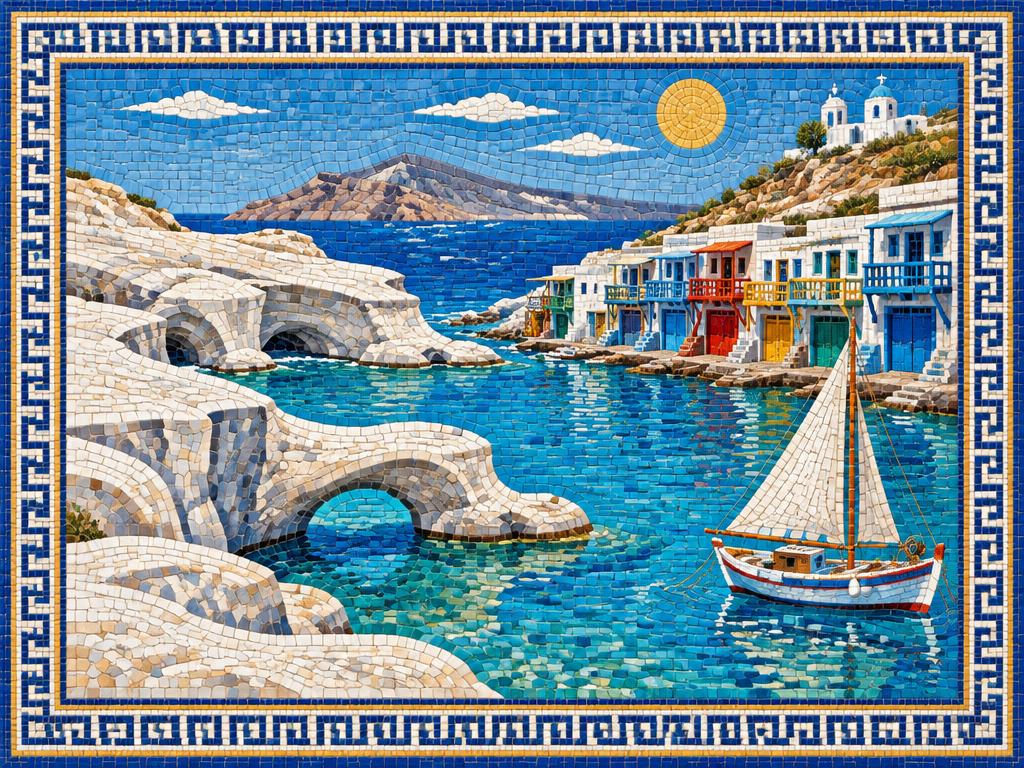
At Sarakiniko, pale volcanic deposits have been carved by wind and water into smooth ridges, channels and hollows. The result resembles a lunar coastline, though the moon would struggle to provide the swimming. Bare rock reflects the sun fiercely, and rough seas can make water access dangerous.
Kleftiko is usually visited by boat for its white cliffs, arches and clear water; experienced hikers can also reach the area overland on a demanding route. Boat departures depend on wind and sea conditions. At Klima and Mandrakia, colourful syrmata combine boat storage near the water with domestic space, creating working waterfront architecture rather than scenery invented for cameras.
3. Top historical & geological sights
Pair the coastline with the Milos Mining Museum in Adamas to understand why the island's rocks mattered long before the beach photographs.
Volcanic deposits shaped by later erosion
Pale sculpted rock creates an exposed coastal landscape where swimming conditions depend heavily on the sea.
Early Christian centuries; commonly c. second–fifth century AD
Burial galleries near Trypiti preserve an important early Christian cemetery with controlled visitor access.
Volcanic coastal formations altered by erosion
Boat excursions explore the white cliffs and arches when weather permits, while pirate stories require more caution than the geology.
Surviving marble theatre mainly Roman period
The restored theatre overlooks the sea near the ancient city and the marked Venus discovery area.
4. The Milos table: what to eat
Look for local cheese pastries and karpouzopita, a watermelon sweet associated with Milos and other Cycladic islands rather than securely attributable to one inventor.
Traditional island cheese pastry
Small folded pies are fried crisp around a local cheese filling that may include onion or pepper.
Cycladic seasonal sweet tradition
Watermelon pulp becomes a baked pie with flour, honey or sugar, olive oil and sesame in varying household recipes.
Post-Columbian tomato; modern Cycladic taverna tradition
Tomato fritters pair well with the sharp flavour of capers gathered or cultivated on the islands.
5. Explorer's conclusion
Allow several days and keep the coastal itinerary flexible: wind direction matters more than the order on your wish list. Reserve a Kleftiko boat trip with time for a weather-related change, visit Sarakiniko early and check the catacombs' current entry arrangements. Bring water, firm footwear and sun protection for exposed archaeological sites.
Leave room for Trypiti, the theatre and a slow look at the fishing settlements without blocking doors or treating occupied homes as props. Milos offers unusually close contact between geology and human history: the same island supplied cutting edges, building material and a remarkably persuasive reason to sit by the sea.
Site by Dan Vineyard — images and site © 2026