 Back to the Atlas
1. Mycenae, Greece: A rich history
Mycenae rose above the Argolid plain to become one of the principal centres of Late Bronze Age Greece. Wealthy shaft graves of the seventeenth and sixteenth centuries BC reveal an elite with access to gold, weapons and far-reaching exchange networks. The site later gave its name to Mycenaean civilisation, whose Linear B records preserve an early form of Greek.
The palace and fortifications developed over successive building phases, especially during the fourteenth and thirteenth centuries BC. Later Greeks called the enormous masonry Cyclopean, believing such stones required the strength of the Cyclopes. The builders were human, even if their lifting arrangements invite sympathy.
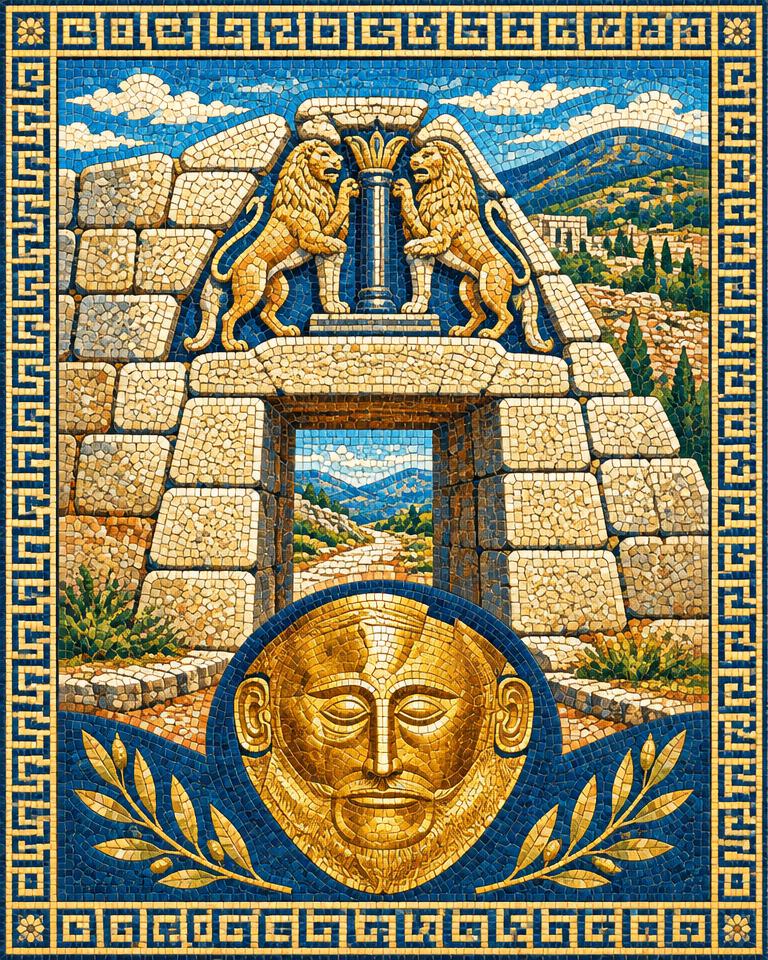
Homer presents Mycenae as the kingdom of Agamemnon, leader of the Greek expedition against Troy. These poems took shape centuries after the palatial period and cannot be read as contemporary court records. The famous Mask of Agamemnon, found in 1876 during excavations directed by Heinrich Schliemann, dates to the sixteenth century BC, centuries before the conventional setting of the Trojan War; its owner's identity is unknown.
Destruction around 1200 BC accompanied the wider collapse of Aegean palace systems, although occupation did not immediately cease. Much later, Argos destroyed the remaining independent community in 468 BC. Modern excavation has recovered a history more complex than either a single heroic dynasty or one dramatic disaster.
2. The Lion Gate & the royal tombs
The Lion Gate, built around 1250 BC, controls the main approach to the citadel. Its relief shows two felines flanking a column; their missing heads leave aspects of their original appearance uncertain. It is among Europe's earliest surviving monumental relief sculptures, rather than the continent's first sculpture of any kind.
Inside lies Grave Circle A, an older burial ground incorporated into the expanded fortifications. Outside the walls, the Treasury of Atreus is a monumental tholos tomb, not a treasury securely belonging to Homer's Atreus. Its corbelled chamber is roughly 14.5 metres across and 13.2 metres high, an extraordinary interior made by progressively projecting stone courses inward.
3. Top historical sights
Mycenaean; approximately 1250 BC
Pass beneath the monumental feline relief and inspect the enormous blocks of the main citadel entrance.
Thirteenth century BC; commonly dated around 1250 BC
Enter the vast corbelled burial chamber whose traditional name does not identify its unknown occupant.
Mainly sixteenth century BC; excavated in 1876
See the shaft-grave enclosure that yielded royal burial goods now largely displayed in Athens.
Local finds spanning prehistoric and later occupation
Use the site's museum to connect the walls and tombs with pottery, craftwork and daily life.
4. The Argolid table: what to eat
The plain below offers a greener counterpoint to the stony citadel, while nearby Nemea provides a natural wine-country detour. These are regional food traditions, not a reconstructed menu from Agamemnon's dining room.
Ancient regional viticulture; modern PDO established in 1971
Try a local red made from Agiorgitiko, ranging from fresh and fruit-driven to fuller barrel-aged styles.
Modern commercial groves expanded from the nineteenth century onward
Look for fresh local oranges or juice when in season on the irrigated plain below Mycenae.
Regional handmade pasta tradition
Try hand-shaped pasta commonly dressed with hot oil or butter and grated cheese, with tomato versions also available.
5. Explorer's conclusion
Visit early, take water and expect uneven paths with little shade. Allow time for the museum and the separately approached Treasury of Atreus rather than stopping at the gate alone. Nafplio makes a practical base, though public transport connections need checking rather than optimistic assumptions.
Mycenae works best when legend and archaeology remain in conversation without being mistaken for each other. The gold cannot tell us its owner's name, but the walls make a sufficiently forceful introduction to the society that built them.
Site by Dan Vineyard — images and site © 2026