 Back to the Atlas
1. Sparta & Mystras, Greece: A rich history
Sparta & Mystras brings together two very different centres of power in the Eurotas valley. Ancient Sparta developed into the leading military state of the Peloponnese, sustained by the labour of an unfree helot population. Its celebrated discipline had a human cost that the souvenir helmets tend to omit.
In 480 BC, Leonidas led 300 Spartan citizens to Thermopylae alongside thousands of Greek allies; Thespians and Thebans also remained in the final defence. Sparta later defeated Athens in the Peloponnesian War, which ended in 404 BC, but its own dominance suffered a decisive blow at Leuctra in 371 BC.
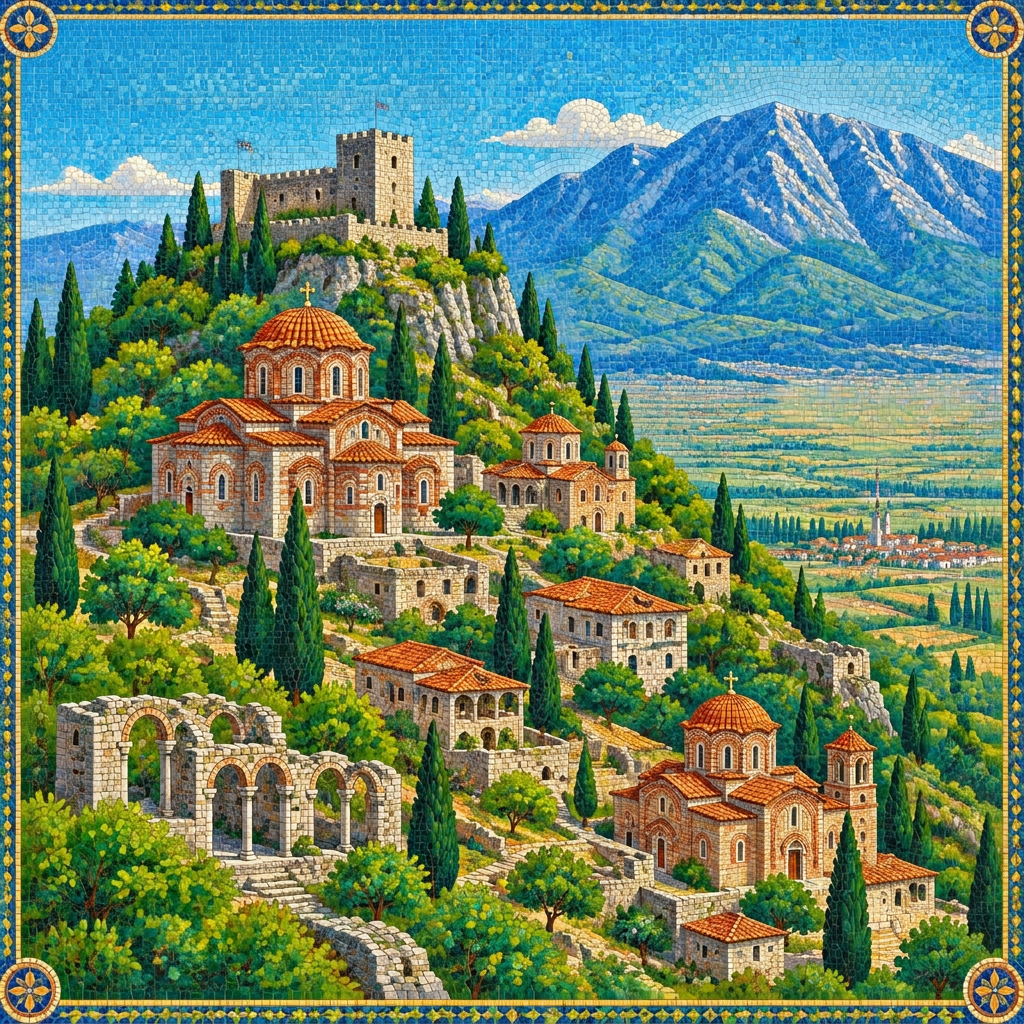
The medieval story belongs to Mystras. William II of Villehardouin, the Frankish prince of Achaea, built its hilltop castle in 1249. It passed to Byzantine control in 1262 and became the seat of the Despotate of the Morea in the fourteenth century, drawing administrators, artists and scholars onto the slopes below the fortress.
The philosopher Gemistos Plethon taught here during the city’s fifteenth-century flowering. Constantine XI, the last Byzantine emperor, was acclaimed emperor at Mystras in January 1449; the cathedral is traditionally associated with the ceremony, although its precise form and location are debated. Ottoman forces took the city in 1460, seven years after Constantinople fell.
Venetian and renewed Ottoman rule followed. Mystras declined through war and population movement, especially after modern Sparta was founded in 1834, but it was not emptied overnight. Its archaeological site became UNESCO-listed in 1989, and the Pantanassa monastery still has a religious community: “ghost city” requires that small correction.
2. From the Spartan plain to Byzantine Mystras
Begin in Sparta with the ancient acropolis and the Sanctuary of Artemis Orthia. The sanctuary’s long history includes rites involving young Spartans; the spectacular whipping contests described by later writers should not be treated as an unchanged practice stretching neatly back through every Spartan century.
Mystras demands more walking and rewards it generously. Follow the churches, monastic courts and surviving streets between the lower town and the castle, looking for frescoes rather than expecting furnished interiors. The Peribleptos church preserves an especially important fourteenth-century painted cycle.
Distinguish Sparta’s modern bronze Leonidas monument, erected in 1968, from the ancient marble warrior torso popularly called “Leonidas” in the archaeological collection: the ancient figure’s identity is uncertain. Check current museum access and palace access before planning your day around either interior.
3. Top historical sights
Castle founded 1249; Byzantine flowering 14th–15th centuries
Explore a UNESCO-listed hillside of churches, monasteries, palaces and defensive walls above the Spartan plain.
Bronze monument 1968; ancient collection spans several periods
Compare the modern memorial with finds from ancient Sparta while remembering that the marble warrior’s identification as Leonidas is uncertain.
Cult attested from the early first millennium BC
This riverside sanctuary illuminates Spartan religion and the changing rituals associated with the education of boys.
For the broadest context, read about UNESCO’s Mystras listing before climbing into the ruins.
4. The Lakonian table: what to eat
Traditional fruit-preserving culture
Bitter-orange peel preserved in syrup makes a fragrant accompaniment to coffee in this citrus-growing region.
Traditional festive pastry
Thin fried dough folded or rolled and dressed with honey and walnuts remains a favourite at Lakonian weddings.
Regional pork-curing tradition
Smoked pork preserved with fat or olive oil often carries the scent of local citrus.
Order synglino with bread and something fresh; the Spartans’ reputation for austerity is not a binding restaurant policy.
5. Explorer's conclusion
Allow two days if you want both ancient Sparta and Mystras without reducing either to a photograph. Start the hillside early, wear shoes with grip and carry water; steps and uneven paths make this more than a gentle village stroll. Check current entrances, transport and monument access before setting out.
The pleasure of Sparta & Mystras is the contrast: a famous ancient power surviving in scattered remains, and a medieval city still visibly climbing toward its castle. One left a formidable reputation; the other left rather more walls.
Site by Dan Vineyard — images and site © 2026