 Back to the Atlas
1. Naxos, Greece: A rich history
Naxos is the largest Cycladic island, with fertile valleys beneath Mount Zas and marble deposits that helped shape its early prosperity. During the third millennium BC, Cycladic communities produced the marble figures now familiar from museums; later Naxian sculptors and patrons became prominent across the Aegean.
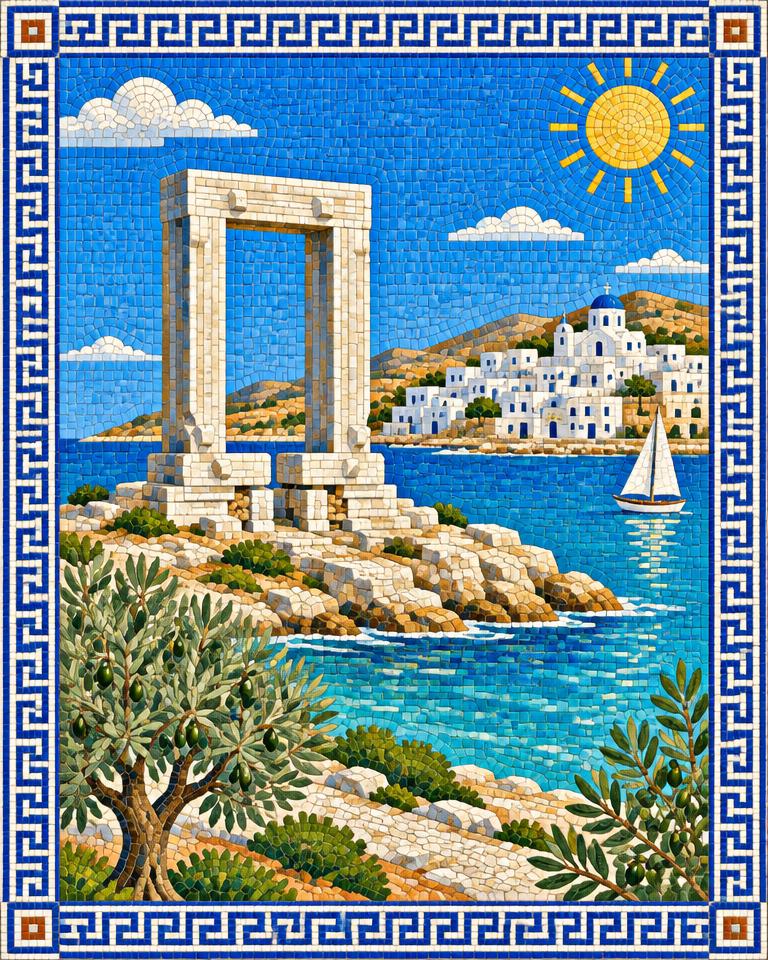
In the sixth century BC, the ruler Lygdamis presided over an ambitious building programme. The enormous Portara, usually identified as the doorway of a temple to Apollo, belongs to this period, around 530 BC. The temple was never completed, and its dedication is not beyond scholarly debate.
Naxos participated in the Greek resistance to Persia in 480 BC and subsequently joined the Athenian-led Delian League. Its attempted withdrawal in the fifth century BC ended in subjugation by Athens: membership terms were rather less optional than the name suggested.
After centuries within the Roman and Byzantine worlds, the island became the centre of Marco Sanudo's Duchy of the Archipelago around 1207. Chora's Kastro preserves this Latin ruling presence; direct Ottoman administration followed in 1566, and Naxos became part of the independent Greek state in 1830.
2. The Portara, Chora & the inland sanctuary
The Portara stands on the islet of Palatia, reached by a causeway from the harbour. Its surviving marble doorway frames the sea and draws a substantial sunset audience, so come earlier if you want room to contemplate antiquity without someone else's phone in it. Avoid the crossing when waves make it unsafe.
Behind the waterfront, Chora's lanes climb towards the Kastro, where medieval buildings and Catholic institutions recall the island's Latin rulers. Inland, the Temple of Demeter at Sangri, built around 530 BC, offers a different setting: a partly reconstructed marble sanctuary surrounded by farmland rather than souvenir shops.
Continue towards Halki and Apiranthos for village streets, stone architecture and mountain views. Leave time for the journey itself; inland Naxos rewards slow travel more reliably than an ambitious list of stops.
3. Top historical sights
Start with the island's ancient marble monuments, then explore the medieval streets of Chora's Kastro.
Archaic; c. 530 BC
This giant marble doorway survives from an unfinished temple usually identified with Apollo.
Archaic; c. 530 BC
The partly reconstructed marble sanctuary reveals the refined architecture of sixth-century BC Naxos.
Latin duchy; c. 1207–1566
Whitewashed lanes surround a hilltop castle district shaped by the island's Latin rulers.
4. The Naxian table: what to eat
Fertile land and livestock make the local table unusually substantial for a Cycladic island. Look for Graviera Naxou and finish with a small glass of kitron; its fragrance comes from citron leaves, not simply squeezed fruit.
Local cheesemaking tradition; PDO 1996
This rich cheese is made mainly from cow's milk, sometimes with a smaller proportion of sheep's or goat's milk.
Cultivated locally since the 19th century
The island's prized potatoes make a persuasive case for ordering another plate of chips.
Commercial distillation since the 19th century
This fragrant local spirit is distilled using citron-tree leaves and comes in several strengths.
5. Explorer's conclusion
Allow at least two full days for Chora, Sangri and a village circuit, with longer if beaches matter. Check current opening hours for archaeological sites, and use a car or carefully planned buses for inland travel. Agios Prokopios and Plaka provide an easy seaside counterweight to marble and mountain roads.
Naxos makes most sense when its monuments and working countryside share the itinerary. Spend a morning among ancient columns, an afternoon in a village square and an evening watching the Portara darken against the sky; history is easier to absorb when dinner is already arranged.
Site by Dan Vineyard — images and site © 2026