 Back to the Atlas
1. Olympia, Greece: A rich history
Olympia developed as a sanctuary in the valley of the Alfeios and Kladeos rivers, not as an ordinary city. Its sacred enclosure, the Altis, became a major centre for the worship of Zeus. The conventional starting date for the Olympic Games is 776 BC, the beginning of the surviving victor tradition rather than a securely documented first sporting event.
Held every four years, the festival brought competitors and visitors from across the Greek world. Athletic contests formed part of a religious gathering involving sacrifices and dedications. The sacred truce protected participation and travel; it did not reliably persuade every Greek state to stop fighting everywhere.
The fifth-century BC Temple of Zeus housed the enormous gold-and-ivory statue made by Phidias, later counted among the Seven Wonders. Roman patrons added buildings, and the sanctuary continued to attract competitors under imperial rule.
The Games ended in late antiquity, traditionally around AD 393 in connection with Theodosius I's measures against pagan worship, though the exact final date and mechanism are uncertain. Earthquakes, flooding and sediment subsequently transformed the site. Systematic German excavations began in 1875, recovering the sanctuary beneath the accumulated earth.
2. The sacred enclosure & the stadium
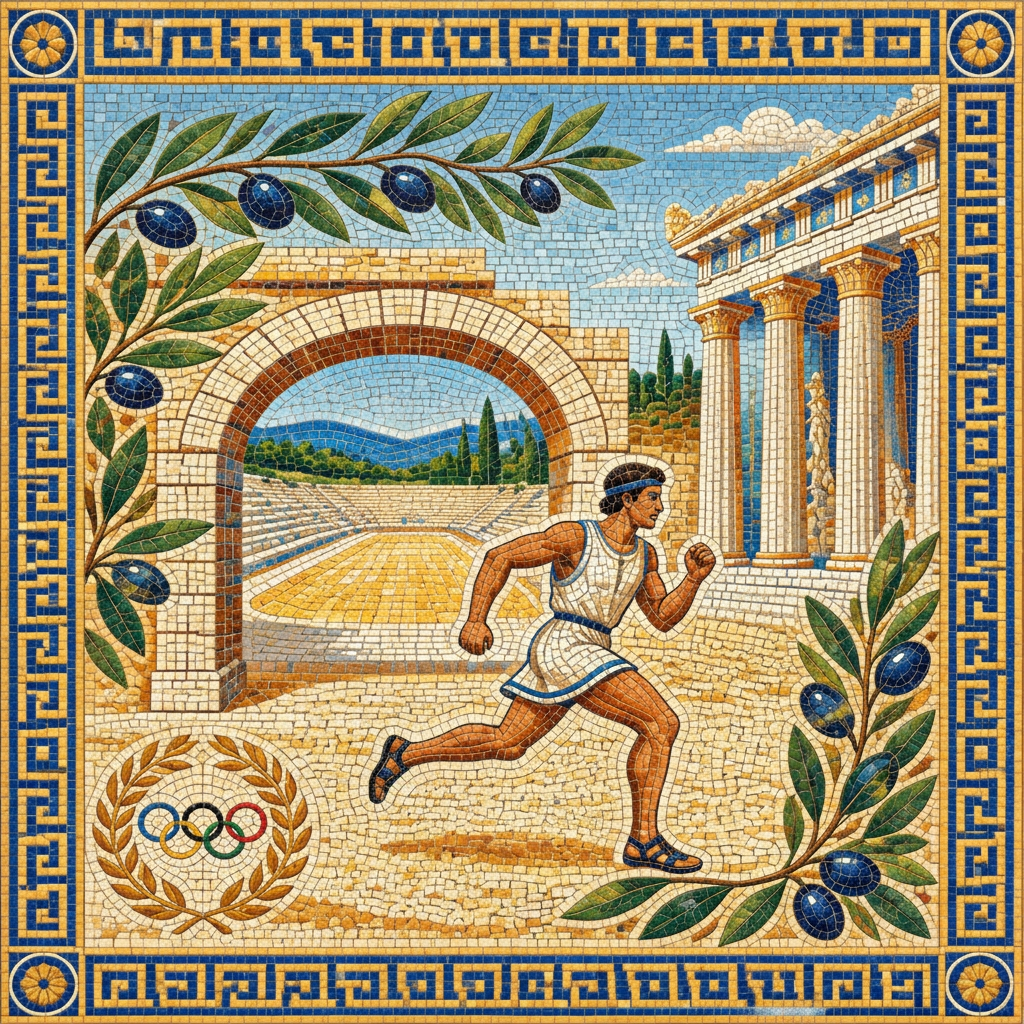
Walk through the Altis before approaching the stadium through its vaulted entrance passage. The surviving track belongs mainly to the fourth-century BC arrangement and measures about 192 metres between its starting and finishing lines. The entrance vault is later, so the entire scene should not be assigned one construction date.
The Temple of Zeus survives largely as foundations and fallen column drums, but its sculptures in the Archaeological Museum of Olympia restore some sense of its ambition. Near the Temple of Hera, the modern Olympic flame is ceremonially kindled using sunlight before each Games; this ceremony began in 1936, rather than continuing uninterrupted from antiquity.
3. Top historical sights
Present layout mainly fourth century BC; Games traditionally from 776 BC
Enter through the later vaulted passage and follow the approximately 192-metre racecourse.
Built approximately 470–456 BC
Trace the footprint of the great Doric temple whose lost cult statue was one of the Seven Wonders.
Collections from prehistory to late antiquity
See the temple sculptures and the Hermes traditionally attributed to Praxiteles, whose authorship and dating remain debated.
Fifth century BC; later converted into a church
Visit the workshop identified through its layout and finds associated with making the statue of Zeus.
4. The Peloponnesian table: what to eat
The surrounding countryside provides a useful reminder that Olympia belongs to an agricultural region as well as to sporting history. Sample local olive oil, but distinguish the victors' ancient wild-olive wreaths from the cultivated olives supplying today's table.
Traditional village spit-roasting
Order large pieces of slowly spit-roasted pork, usually served with bread, potatoes or salad.
Olive cultivation since antiquity
Taste local extra-virgin oil, often made from Koroneiki olives, for its grassy flavour and peppery finish.
Traditional festive sweet; precise origins uncertain
Finish with thin fried pastry folded or rolled and dressed with honey and walnuts.
5. Explorer's conclusion
Give the archaeological site and museum most of a day, starting outdoors before the heat builds. Carry water, wear shoes suited to uneven ground and check current opening hours. Staying in modern Olympia makes an early visit straightforward.
The stadium is striking precisely because so little intervenes between you and its original purpose: a long strip of earth, a starting line and spectators' slopes. Running it is optional; appreciating the distance requires considerably less training.
Site by Dan Vineyard — images and site © 2026