 Back to the Atlas
1. Patmos, Greece: A rich history
Patmos enters Christian history through the Book of Revelation, whose author names himself John and says he was on the island because of the word of God. Tradition understands this as Roman exile around AD 95, during Domitian’s reign. The date and the author’s identification with John the Apostle remain matters of scholarly debate.
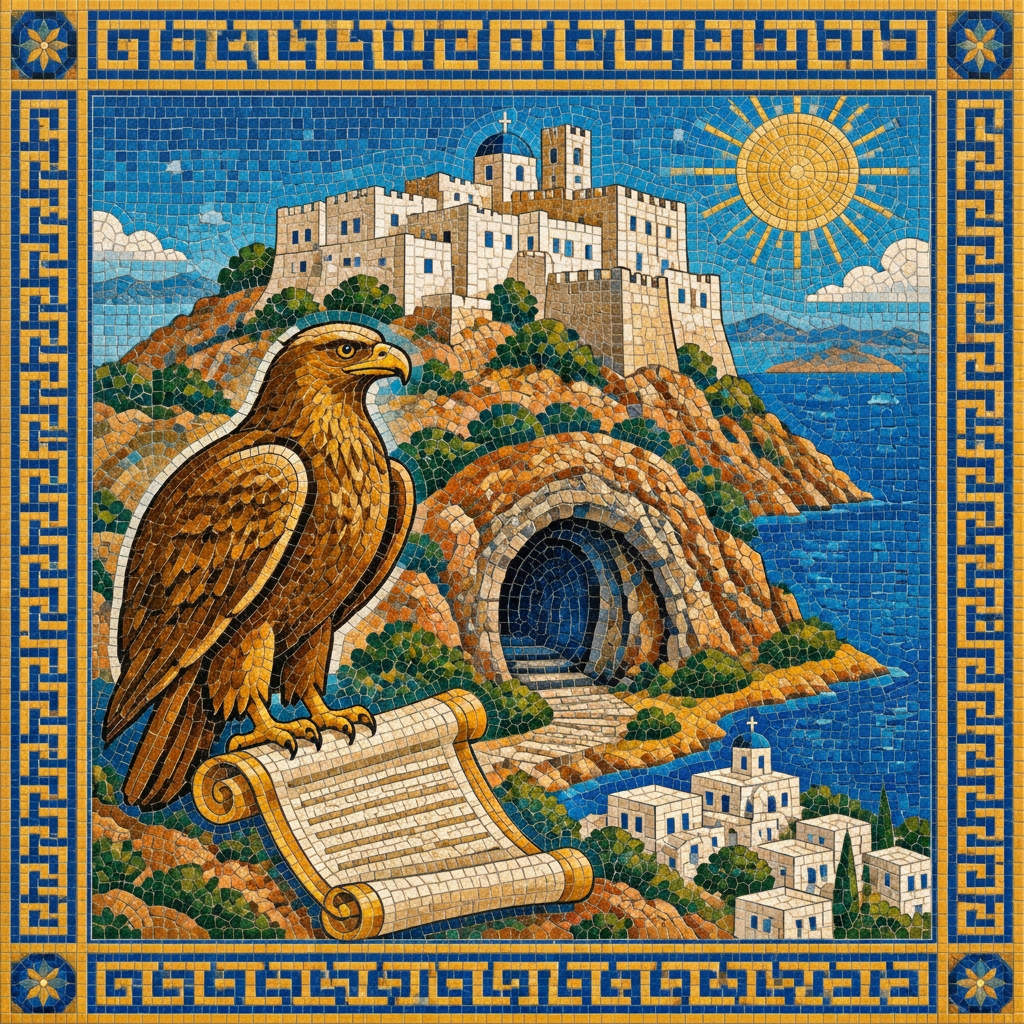
The Cave of the Apocalypse is traditionally identified as the place of John’s visions. Its divided rock is associated in local religious tradition with God’s voice; that is a statement of faith, not an archaeological explanation of a fissure. The island’s sacred geography gives a physical setting to a text that has travelled far beyond the Aegean.
In 1088, Emperor Alexios I Komnenos granted Patmos to the monk Christodoulos, who founded the Monastery of Saint John the Theologian. Its fortified form developed over centuries, protecting a religious community that accumulated icons, manuscripts and substantial influence.
Chora grew around the monastery, with many surviving houses dating to the sixteenth and seventeenth centuries. Patmos passed under Ottoman sovereignty, later came under Italian rule in 1912, and joined Greece with the Dodecanese in 1948. Chora, the monastery and the cave were inscribed together on UNESCO’s World Heritage List in 1999.
2. The cave, the monastery & Chora
The Cave of the Apocalypse lies on the hillside between Skala and Chora. It remains a place of worship, so enter quietly and follow local guidance on dress and photography. A visit is better approached as a small sacred interior than a theatrical reconstruction of the end of days.
Continue uphill to the monastery and its treasury, then wander Chora, where narrow lanes pass whitewashed walls and captains’ houses. The ridge-top windmills provide a useful landmark beyond the monastery; leave time simply to walk, rather than treating the whole town as a corridor to one ticket desk.
3. Top historical sights
Check access to the monastery treasury separately from the surrounding town.
Traditionally associated with Revelation, c. AD 95
This working shrine marks the grotto where John is traditionally said to have received his visions.
Founded 1088
Fortified walls enclose a monastic complex with frescoes, icons and a treasury of manuscripts.
Medieval origins; many houses 16th–17th century
The hill town wraps lanes and captains’ mansions around the monastery’s commanding walls.
4. The Patmian table: what to eat
Ask bakeries about Patmian cheese pie, and let the day’s catch guide a harbour meal rather than insisting on a particular fish.
Island Easter baking tradition
Fluted pastry holds a generous sweet-savoury cheese filling, with recipes varying between bakers.
Dodecanese pastry tradition
These little pastry pouches often enclose nuts and honey in a satisfyingly compact sweet.
Island fishing tradition
Choose an available local catch at a Skala taverna and confirm the weight-based price before ordering.
5. Explorer's conclusion
Allow two or three days, pairing the cave and monastery with time in Skala and a quiet bay. Check religious-site visiting hours, wear respectful clothing and avoid walking the exposed hillside in midday heat. Psili Ammos may involve a walk or seasonal boat trip, while Lambi is known for its pebbled shore.
Patmos has a dramatic literary reputation but an often gentle daily rhythm. After the battlements and visions, the most persuasive ending may be a harbour table and the simple business of watching a boat come in.
Site by Dan Vineyard — images and site © 2026