 Back to the Atlas
1. Samos, Greece: A rich history
Samos became a prosperous maritime power in the Archaic Greek world, trading widely across the Mediterranean. Its sanctuary of Hera developed over many centuries beside the river Imbrasos, where local tradition placed the goddess's birth. Successive temples grew increasingly ambitious; restraint was not the sanctuary's defining architectural principle.
Under the tyrant Polycrates, who ruled approximately from 538 to 522 BC, Samian naval power reached its height. Herodotus admired the island's major engineering works, including the harbour mole and the Eupalinian tunnel. The aqueduct tunnel, usually dated to the sixth century BC and associated with Polycrates' era, was driven through a mountain from opposite ends under the engineer Eupalinos of Megara.
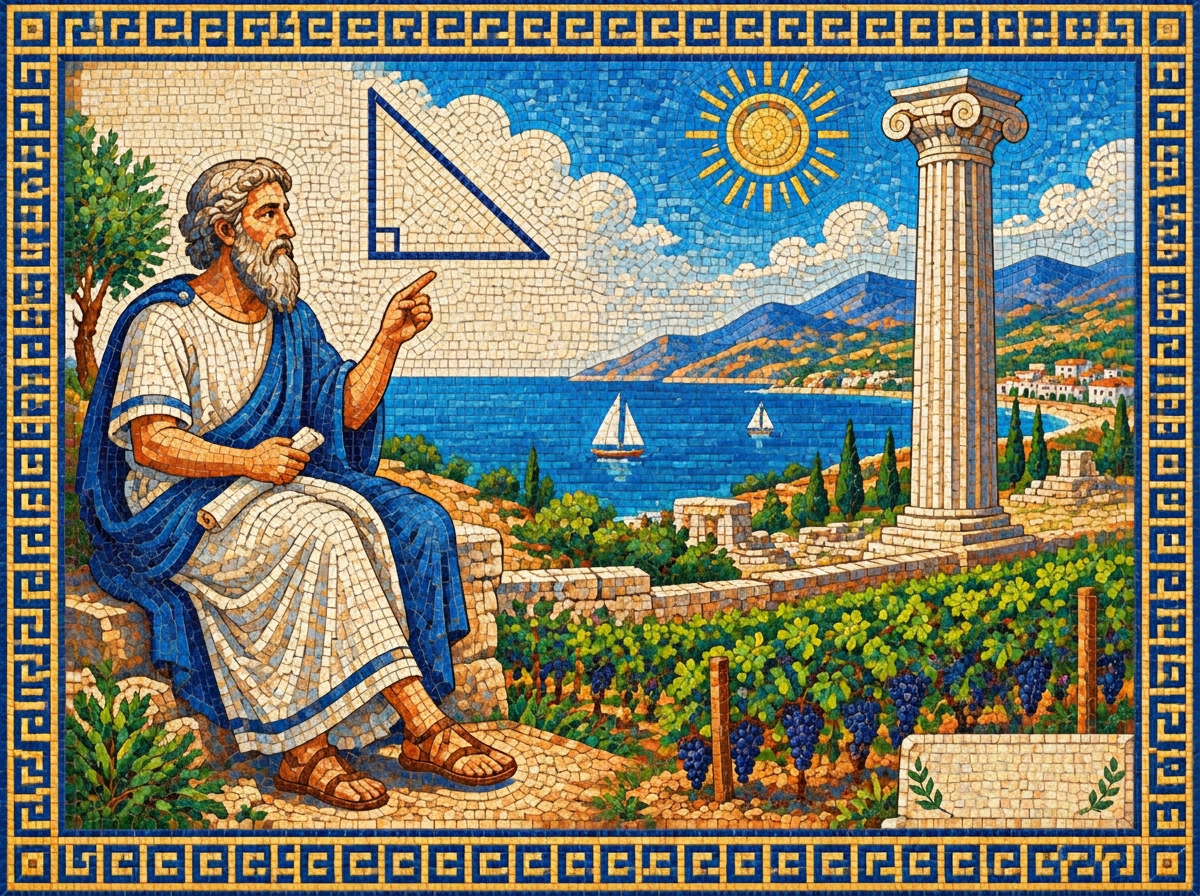
Pythagoras was born on Samos around 570 BC and later established his community at Croton in southern Italy. Much of his biography comes from considerably later sources, so confident stories about his daily habits deserve a little caution. Samos subsequently experienced Persian domination, Athenian intervention and rule within the Hellenistic and Roman worlds.
After Byzantine, Genoese and Ottoman chapters, Samos became an autonomous principality under Ottoman suzerainty in 1834 and united with Greece in 1912. Its ancient sanctuary and harbour town were jointly inscribed on UNESCO's World Heritage List in 1992. The island's modern identity also rests on working vineyards, mountain villages and a coast that remains more than an archaeological footnote.
2. The tunnel, Heraion & Pythagoreio harbour
Base an archaeological day around Pythagoreio, the modern harbour town renamed for Pythagoras in 1955. Its waterfront occupies the setting of the ancient port, with ancient harbour engineering surviving beneath and around later works. Cafés now handle most arrivals rather more gently than Polycrates' fleet would have done.
The Eupalinian tunnel runs for roughly 1,036 metres, but the route visitors can enter depends on current arrangements. Check access before travelling: narrow passages, steps and confined spaces make this more demanding than an ordinary museum visit. Continue to the Heraion, where a solitary standing column hints at the scale of the great temple begun around 530 BC. Carry water and sun protection; the goddess has not supplied much shade.
3. Top historical sights
The UNESCO-listed archaeological landscape rewards a combined visit rather than a hurried photograph at each stop.
Sixth century BC; commonly dated c. 530 BC
This mountain aqueduct was excavated from opposite ends, and visitor access varies by route and operating conditions.
Great temple begun c. 530 BC
One standing column marks the immense temple within a sanctuary sacred to Hera for centuries.
Ancient port; town renamed in 1955
The modern waterfront occupies the ancient harbour setting and preserves traces of its monumental maritime works.
4. The Samian table: what to eat
Explore the island's Muscat wine tradition alongside its cheese pastries, remembering that a generous dessert wine is still wine.
Ancient viticulture; cooperative founded in 1934
The island's fragrant sweet wines use white Muscat grapes grown on slopes and terraces.
Traditional island pastry
These small fried pastries commonly combine soft cheese and mint, with sweet finishes in some versions.
Local festive sweet tradition
Fried dough pastries are served with honey, walnuts and cinnamon, with shapes and recipes varying by household.
5. Explorer's conclusion
Allow a full day for Pythagoreio, the tunnel and the Heraion rather than squeezing all three between ferries. Check archaeological opening hours and tunnel restrictions separately, wear shoes with grip and arrange transport beyond the harbour. A second day can take in mountain villages, a winery and Tsamadou beach.
Samos works best when its achievements share the itinerary with ordinary island life: a precisely cut passage through rock, a column in open fields, then a shaded table above the sea. The engineers did the difficult part; your main calculation is how long to stay.
Site by Dan Vineyard — images and site © 2026