 Back to the Atlas
1. Syracuse, Sicily: A rich history
Syracuse is in southeastern Sicily, Italy, but its ancient heart belongs firmly to the Greek world. Corinthian settlers founded the city around 734/733 BC on Ortigia, an island beside a sheltered harbour. It was already an inhabited landscape, not an empty shore. The settlement expanded onto the mainland and became one of the Mediterranean’s most powerful Greek cities.
Under Gelon in the early fifth century BC, Syracuse grew into a regional power. A Greek coalition defeated Carthaginian forces at Himera in 480 BC; monumental building at Syracuse followed. In 415–413 BC, Athens launched its disastrous Sicilian Expedition. Its defeat here changed the course of the Peloponnesian War, and surviving Athenian prisoners were confined in the stone quarries.
Dionysius I, who ruled from 405 to 367 BC, strengthened the city’s walls and fought for control of Sicily. Plato’s visits to the courts of Syracuse in the fourth century became a famous, troubled encounter between philosophy and political power. The city’s tyrants had many talents; taking constructive feedback was not consistently one of them.
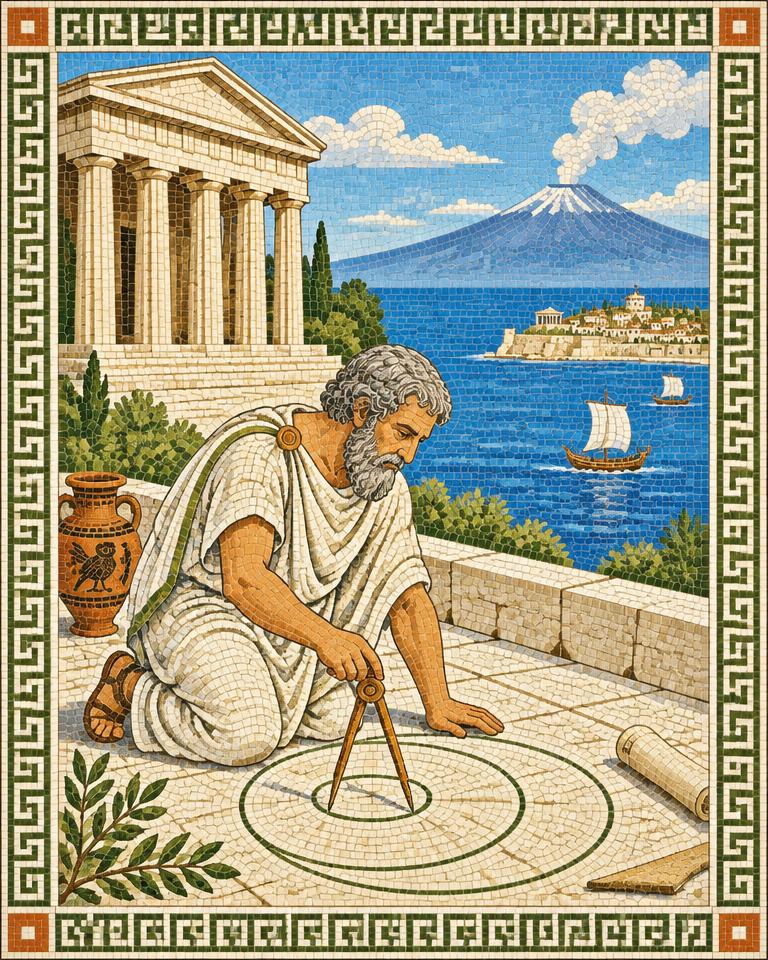
In the third century BC, Hiero II presided over a prosperous kingdom. Archimedes, born around 287 BC, worked on geometry, mechanics and hydrostatics in this intellectual setting. His discoveries are far better established than the details of the famous “Eureka” bath story, which comes from a later account. Ancient writers describe defensive machines during Rome’s siege; the burning-mirror story is later and disputed.
Rome captured Syracuse in 212 BC, during the Second Punic War, and Archimedes was killed. The city remained an important centre of Roman Sicily, with an amphitheatre and continued use of older Greek buildings. By late antiquity, Christian communities had left extensive catacombs. Saint Lucy’s martyrdom is traditionally dated to AD 304, during the persecution under Diocletian; around AD 400, Syracuse was a Roman city increasingly shaped by Christianity.
Byzantine forces took Sicily in the sixth century, and Emperor Constans II resided in Syracuse from 663 until his assassination in 668. Arab forces captured the city in 878; Norman rule followed in the eleventh century. Later Spanish-era government and rebuilding after the earthquake of 1693 helped create the Baroque streets visible today. Syracuse and the nearby rocky necropolis of Pantalica became a UNESCO World Heritage Site in 2005.
2. Ortigia & the ancient city
Walk Ortigia from the Temple of Apollo to Piazza Duomo. The cathedral incorporates substantial columns of the fifth-century BC Temple of Athena into its walls. Its Baroque exterior and ancient stone interior are not competing attractions: they are the same building’s long biography.
Continue to the Fountain of Arethusa, a freshwater spring by the sea associated with the myth of the nymph Arethusa. The papyrus, waterfront and narrow lanes make a welcome change of pace after the ruins. Castello Maniace, built under Frederick II in the thirteenth century, guards the island’s southern tip.
On the mainland, Neapolis Archaeological Park brings together the Greek theatre, Roman amphitheatre and ancient quarries. The theatre has fifth-century BC origins, but its surviving form owes much to third-century BC rebuilding under Hiero II. Greek drama is still staged here: check the INDA programme for the current season.
3. Top historical sights
Theatre origins 5th c. BC; rebuilt 3rd c. BC
A vast theatre cut into the hillside, beside quarries and a Roman amphitheatre. Allow time to walk between the monuments.
Temple 5th c. BC; church conversion Byzantine era
Ancient Doric columns embedded in a living cathedral, behind an eighteenth-century Baroque façade.
Early 6th century BC
One of Sicily’s earliest monumental Doric temples, standing just beyond the bridges into Ortigia.
Ancient quarry; name attributed to Caravaggio, 1608
A tall quarry cavern with striking acoustics. The story of a tyrant listening to prisoners is a legend, not an established use.
Museum finds prehistoric–late antique; catacombs mainly 4th–5th c. AD
Pair regional archaeology with early Christian burial passages; check separate tickets and guided-visit arrangements.
4. The Sicilian table: what to eat
Modern Sicilian street-food tradition; origins debated
Golden fried rice balls, often with ragù, cheese or vegetables. Eastern Sicily generally says arancini; breakfast rules are delightfully flexible.
Local pasta tradition; recipes vary
Syracuse-style pasta often featuring anchovies and toasted breadcrumbs, with variations using tomato, olives or capers.
Sicilian pastry tradition; precise origins uncertain
Crisp pastry shells filled with sweet ricotta, best filled shortly before eating so the shell keeps its crunch.
Sicilian frozen-dessert tradition
A cool almond granita with soft brioche is a classic summer breakfast. Sicily has made a persuasive case for dessert before noon.
5. Explorer’s conclusion
Give Syracuse at least two full days: one for Ortigia’s temples, cathedral and waterfront, another for Neapolis and the archaeological museum. A third day opens up the surrounding coast or Pantalica, which is a separate inland excursion rather than part of the city-centre walk.
Spring and autumn are comfortable for the exposed archaeological sites; in summer, begin early and save shaded lanes and long meals for the heat. Stay on or near Ortigia if evening walks matter most, and allow for the trip to the mainland ruins. Come for Archimedes, but linger for a city where Greek columns, Christian walls and Sicilian cooking all still share the same address.
Site by Dan Vineyard — images and site © 2026