 Back to the Atlas
1. Thessaloniki, Greece: A rich history
Cassander founded Thessaloniki in 315 BC, naming it after his wife, Alexander the Great's half-sister. Its harbour and position on the later Roman Via Egnatia helped it become a major commercial centre, linking the northern Aegean with routes across the Balkans.
In the late third and early fourth centuries AD, the emperor Galerius developed an imperial complex here. The Arch of Galerius and Rotunda survive from that setting, although the Rotunda's original intended function remains debated. Its later conversion to a church brought the extraordinary mosaics still visible inside.
Thessaloniki became one of the Byzantine Empire's leading cities. Its churches preserve successive phases of Christian architecture and decoration, now recognised through the UNESCO-listed Paleochristian and Byzantine monuments. Ottoman forces captured the city in 1430 after a short period of Venetian rule.
Sephardic Jews arriving after their expulsion from Spain in 1492 helped make Ottoman Salonica a major Jewish urban centre. The city joined Greece in 1912; the fire of 1917 and the arrival of refugees from Asia Minor in the 1920s reshaped its streets and population. During the German occupation, deportations in 1943 devastated its Jewish community, a history explored at the Jewish Museum of Thessaloniki.
2. The waterfront, imperial monuments & Ano Poli
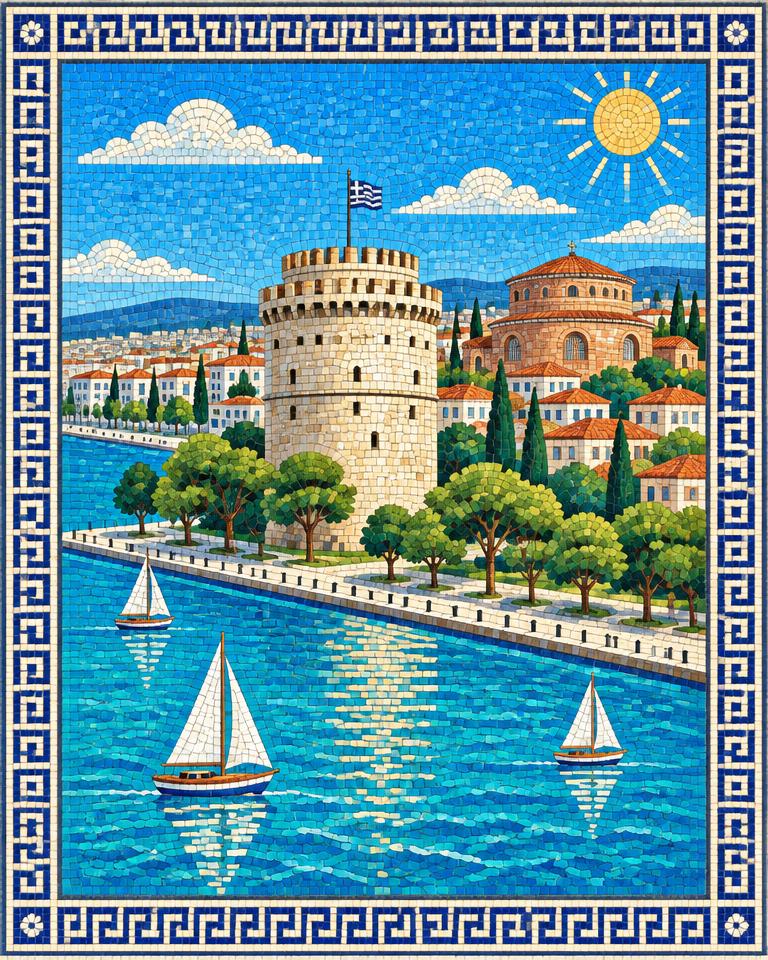
Begin at the Ottoman-era White Tower, built around 1500, then follow the waterfront for views across the Thermaic Gulf. The tower's museum introduces the city, while the promenade supplies the less demanding pleasure of watching everybody else take their evening walk.
Head inland to the Arch of Galerius and the Rotunda, then seek out the Church of Agios Dimitrios. Its early Christian origins, surviving mosaics and crypt repay attention, but the present building also reflects major reconstruction after the 1917 fire.
Climb into Ano Poli for old lanes, surviving houses and stretches of city wall. The ascent is substantial enough to justify a bus or taxi uphill and a walk down; there is no historical obligation to arrive exhausted.
3. Top historical sights
These landmarks span Roman, Christian and Ottoman Thessaloniki; add another of the UNESCO-listed churches if mosaics have caught your attention.
Ottoman; late 15th or early 16th century
The waterfront tower now houses a museum devoted to the city's history.
Roman; around AD 300
The imperial monuments include a massive circular building with important early Christian mosaics.
Early Christian origins; reopened after restoration in 1949
The basilica honours the city's patron saint and preserves mosaics and a crypt beneath its reconstructed fabric.
4. The Thessalonian table: what to eat
Browse Kapani market, then make room for pastry, seafood and shared plates. Byzantine and Ottoman food traditions form part of the background, but exact invention dates for familiar breads and pastries are often harder to establish than confident menus suggest.
Layered pastry tradition; shaped locally by refugee bakers
Try crisp filo enclosing custard or cheese, with sweet versions commonly finished with sugar and cinnamon.
Long-standing sesame-bread tradition
This sesame-coated bread ring is a practical breakfast for walking between monuments.
Local speciality developed in the 1950s
These syrup-soaked pastry triangles filled with cream originated in the Panorama district.
5. Explorer's conclusion
Allow two or three days, grouping waterfront sights separately from the upper town and leaving time for museums. Check monument opening hours and dress respectfully in working churches. Include the Jewish Museum rather than treating the city's Jewish history as a footnote between Roman and Byzantine stops.
Thessaloniki rewards a rhythm of looking closely, walking a little and sitting down to eat. Its past is not confined to one archaeological enclosure: it appears in arches beside traffic, mosaics inside churches and the changing neighbourhoods above the sea.
Site by Dan Vineyard — images and site © 2026