 Back to the Atlas
1. Vergina (Aigai), Greece: A rich history
Vergina stands beside ancient Aigai, the first capital of the Macedonian kingdom and the ancestral burial place of its royal dynasty. Even after the political centre shifted to Pella, Aigai retained its ceremonial importance: kings still came here for occasions that mattered.
In 336 BC, Philip II was assassinated in the theatre during celebrations for his daughter’s marriage. His son Alexander succeeded him and was acclaimed king at Aigai. The palace and theatre belong to the setting of that transition, before Alexander’s campaigns carried Macedonian power across the eastern Mediterranean and into Asia.
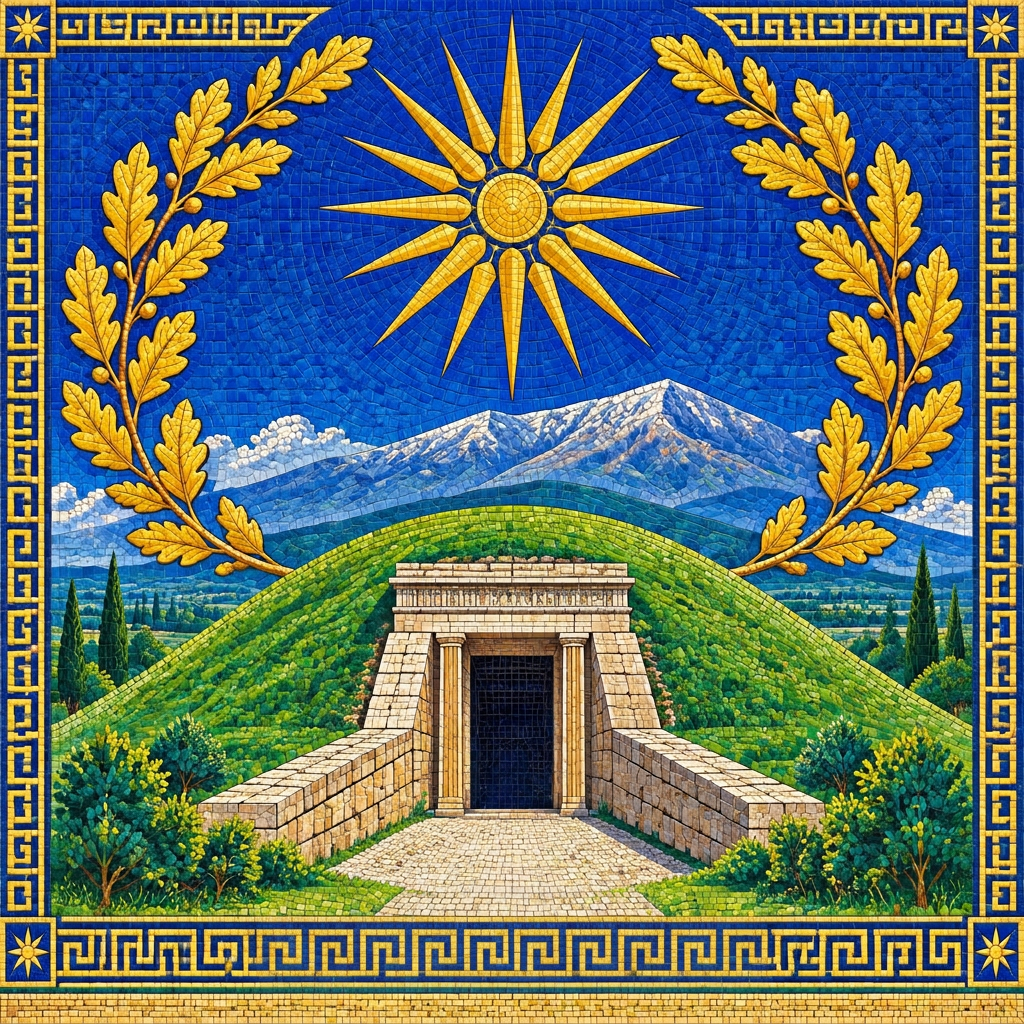
In 1977, archaeologist Manolis Andronikos uncovered remarkable royal burials beneath the Great Tumulus, including two unlooted tombs. Gold burial containers, an oak-leaf wreath, silver vessels and finely worked ivory revealed the resources and craftsmanship of the Macedonian court.
Tomb II is presented by the museum as the burial of Philip II, although its identification has attracted scholarly debate, including proposals involving Philip III Arrhidaeus. Tomb III is generally associated with Alexander IV, Alexander the Great’s son. The site became UNESCO-listed in 1996; the restored palace reopened to visitors in 2024.
2. The royal mound and the palace above
The Royal Tombs museum preserves the tombs in place inside a protective structure shaped like the burial mound. Its subdued lighting directs attention to the painted facades and grave goods rather than to architectural spectacle overhead.
Continue to the palace for the opposite experience: open sky, an enormous courtyard and the footprint of royal power expressed through architecture. The fourth-century-BC complex combined ceremonial rooms, dining spaces and carefully organised circulation; it was not simply a large private house with ambitious catering.
The Polycentric Museum of Aigai adds broader context beyond royal funerals. Treat the museum buildings, palace and theatre area as separate stops, and check current access arrangements rather than assuming every part is always open.
3. Top historical sights
Royal burials late 4th century BC; major discoveries 1977
Stand beside the preserved tomb facades and see gold wreaths, burial containers and banquet equipment from the Macedonian court.
4th century BC; reopened after restoration in 2024
The monumental courtyard and ceremonial spaces reveal the architectural scale of Philip II’s royal centre.
4th century BC; Philip II assassinated here in 336 BC
The surviving theatre marks the setting of the assassination that brought Alexander to the throne.
The UNESCO site description helps connect these scattered remains into one royal landscape.
4. The Macedonian table: what to eat
Ancient regional viticulture; modern Naoussa appellation
This structured red wine from nearby Naoussa is a good partner for substantial Macedonian cooking.
Ottoman-era syrup-cake tradition
Veria’s celebrated semolina cake arrives thoroughly soaked in syrup rather than merely introduced to it.
Commercial orchards expanded during the 20th century
Look for ripe local peaches in summer when the surrounding plain supplies fruit at its freshest.
A stop in Veria for revani makes a natural extension, particularly if your archaeological concentration needs sugar.
5. Explorer's conclusion
Give Aigai a full day if you want the tombs, palace and wider museum displays. Check opening hours and ticket coverage for each part, bring sun protection for the exposed palace and arrange transport between the dispersed stops. Nearby Veria is a practical base for a longer stay.
The power of Vergina (Aigai) lies in the contrast between royal ambition above ground and intimate objects below it. A wreath, a drinking vessel and a painted doorway make the ancient court feel closer than a list of conquests ever could.
Site by Dan Vineyard — images and site © 2026